Artificial Intelligence (AI) and Machine Learning (ML) are transforming how businesses operate, analyse information and make decisions. From personalised recommendations and virtual assistants to fraud detection and predictive analytics, AI-powered technologies are becoming an important part of modern industries.
As companies increasingly adopt intelligent technologies, learning Artificial Intelligence and Machine Learning can open up opportunities for students, fresh graduates and working professionals.
If you are searching for an AI and Machine Learning Course in Bangalore, understanding the essential skills, programming languages, tools and career opportunities can help you choose the right learning path.
At NUCOT, learners can explore Data Science, Python, Machine Learning and Generative AI as part of a structured technical learning journey in Indiranagar, Bangalore.
What Is Artificial Intelligence?
Artificial Intelligence is a branch of computer science that focuses on developing systems capable of performing tasks that generally require human intelligence.
These tasks include understanding language, recognising images, analysing information, solving problems and making predictions.
Some common examples of Artificial Intelligence include:
- Virtual assistants and chatbots
- Recommendation systems on shopping and entertainment platforms
- Facial recognition systems
- AI-powered customer support
- Fraud detection in banking
- Generative AI applications
AI is used across industries such as healthcare, banking, retail, manufacturing, education and information technology.
What Is Machine Learning?
Machine Learning is a subset of Artificial Intelligence that enables computer systems to learn patterns from data and make predictions or decisions without being explicitly programmed for every individual task.
For example, an online shopping platform can use Machine Learning to analyse customer behaviour and recommend products based on previous searches and purchases.
Machine Learning algorithms identify patterns in datasets and improve their predictions based on the information used for training.
Difference Between AI and Machine Learning
| Artificial Intelligence | Machine Learning |
|---|---|
| Broad field of intelligent computing | Subset of AI |
| Focuses on intelligent behaviour and tasks | Focuses on learning from data |
| Includes reasoning, language and perception | Uses algorithms and statistical models |
| Includes rule-based and learning-based systems | Learns patterns from datasets |
Understanding this difference is an important first step before enrolling in an Artificial Intelligence and Machine Learning Course.
Why Learn AI and Machine Learning in 2026?
AI adoption is creating demand for professionals who can work with data, develop predictive models and understand intelligent applications.
Here are some reasons learners are exploring AI and ML:
1. Growing use of AI across industries
Organisations are adopting AI for automation, customer experience, forecasting and business intelligence.
2. Opportunities across technical domains
AI and ML knowledge can complement careers in software development, data analytics, business intelligence and data science.
3. Practical problem-solving skills
Learners gain exposure to analysing datasets, identifying patterns, building models and evaluating results.
4. Emerging Generative AI applications
Large Language Models (LLMs), AI assistants and generative applications are expanding the scope of AI-related work.
5. Opportunities for continuous learning
AI technologies continue to evolve, making ongoing technical learning and project experience valuable.
Essential Skills Required to Learn AI and Machine Learning
You do not necessarily need to be an expert programmer before starting. However, developing a foundation in programming, mathematics and data analysis makes learning easier.
1. Python Programming
Python is widely used in Data Science, AI and Machine Learning because of its readable syntax and extensive library ecosystem.
Important Python concepts include:
- Variables and data types
- Conditional statements and loops
- Functions and modules
- Lists, tuples and dictionaries
- Object-oriented programming
- File handling
2. Mathematics and Statistics
Mathematical concepts help learners understand how Machine Learning algorithms work.
Important topics include:
- Linear algebra
- Probability
- Descriptive statistics
- Inferential statistics
- Calculus fundamentals
- Hypothesis testing
3. SQL and Database Knowledge
AI and ML projects frequently involve collecting and preparing information from databases.
SQL helps learners retrieve, filter, organise and analyse structured data.
4. Data Analysis and Visualisation
Before building a Machine Learning model, learners need to understand the dataset.
Useful skills include:
- Data cleaning
- Exploratory Data Analysis (EDA)
- Handling missing values
- Data visualisation
- Identifying trends and patterns
5. Machine Learning Concepts
Learners should understand the different types of Machine Learning:
- Supervised Learning
- Unsupervised Learning
- Reinforcement Learning
They should also understand model training, testing, evaluation and performance improvement.
6. Generative AI and Large Language Models
Modern AI learning increasingly includes Generative AI concepts.
Learners can explore:
- Large Language Models
- Prompt engineering
- AI-powered applications
- Retrieval-Augmented Generation (RAG)
- Working with AI APIs
- Responsible AI practices
Tools and Technologies Used in AI and Machine Learning
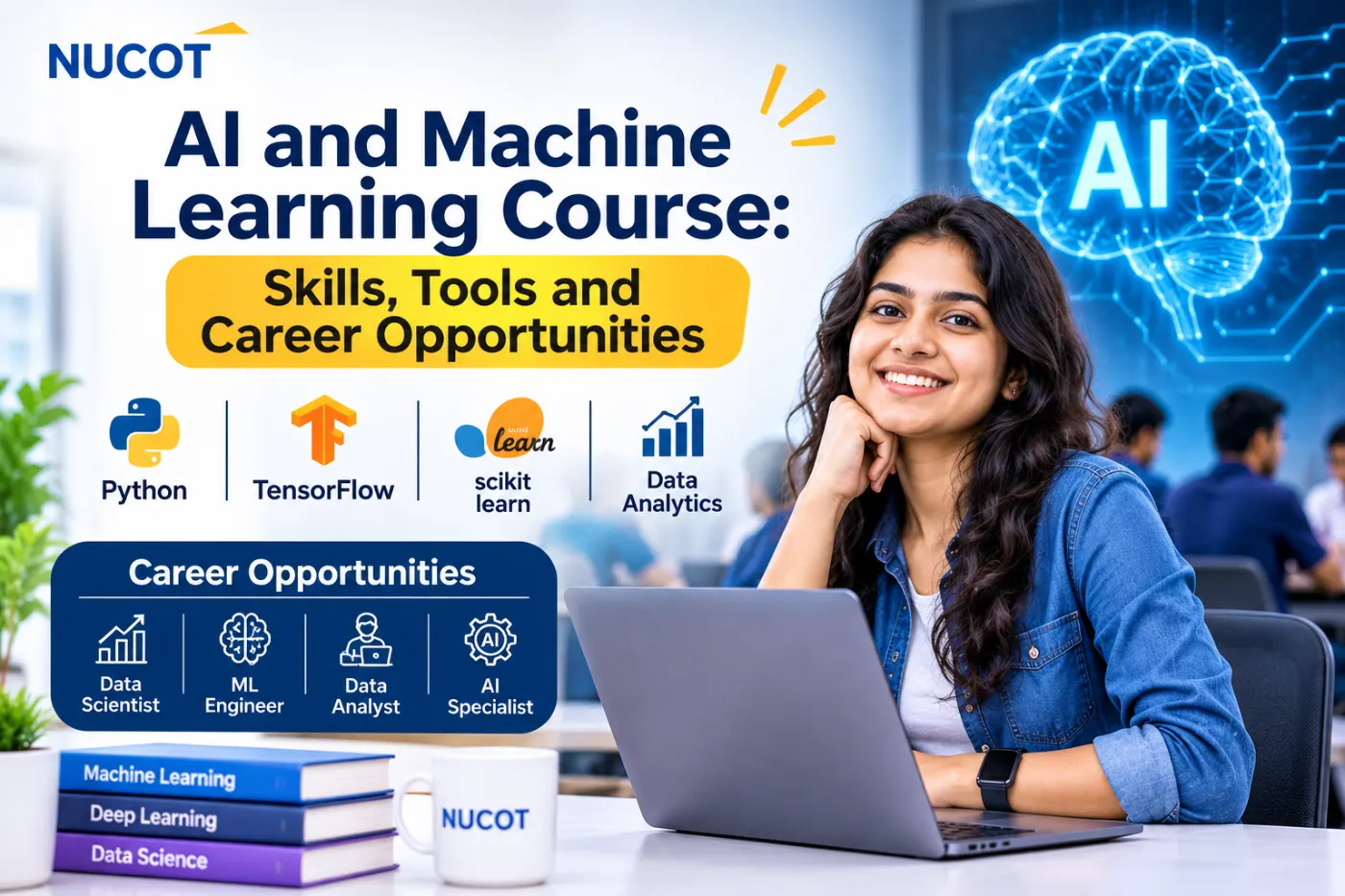
Choosing an data science course in bangalore AI and ML course that provides exposure to relevant tools can help learners connect theoretical concepts with practical applications.
| Tool or Technology | Application |
|---|---|
| Python | Programming and data processing |
| NumPy | Numerical computations |
| Pandas | Data manipulation and analysis |
| Matplotlib | Data visualisation |
| Seaborn | Statistical visualisation |
| Scikit-learn | Machine Learning algorithms |
| TensorFlow | Deep Learning |
| PyTorch | Deep Learning and neural networks |
| Jupyter Notebook | Interactive coding and experimentation |
| SQL | Database querying |
| Power BI | Business intelligence and reporting |
Learners do not need to master every tool immediately. Building a strong foundation in Python, SQL, data analysis, and Scikit-learn is a practical starting point.
Career Opportunities After Learning AI and Machine Learning
AI and ML skills can support different career paths depending on a learner’s educational background, technical abilities, project experience and practical knowledge.
Some career roles include:
1. Machine Learning Engineer
Machine Learning Engineers develop, train and improve algorithms that enable applications to identify patterns and make predictions.
2. AI Engineer
AI Engineers work on intelligent applications, AI-powered systems, automation and the integration of AI technologies into business solutions.
3. Data Scientist
Data Scientists analyse complex datasets, identify patterns, develop predictive models and communicate insights that support business decisions.
4. Data Analyst
Data Analysts collect, clean and analyse information to identify trends and prepare reports using tools such as Python, SQL and Power BI.
5. NLP Engineer
Natural Language Processing professionals work on technologies that help computers understand and process human language.
6. Generative AI Developer
Generative AI Developers build applications using LLMs, AI APIs, prompt engineering and related technologies.
The availability of these roles depends on employer requirements and the candidate’s actual skills. Completing a course alone does not guarantee employment.
Can Freshers and Non-IT Graduates Learn AI and Machine Learning?
Yes. Students from different educational backgrounds can begin learning AI and Machine Learning with a structured approach.
Graduates from BCom, BBA, BA, BSc, BCA, BTech and other disciplines can explore this field.
However, the learning roadmap may differ based on prior programming and mathematical knowledge.
For beginners, a practical learning sequence is:
- Learn Python programming fundamentals.
- Understand SQL and database concepts.
- Develop mathematical and statistical foundations.
- Learn data cleaning and exploratory analysis.
- Understand Machine Learning algorithms.
- Work on practical datasets and projects.
- Explore Generative AI and LLM applications.
- Prepare a portfolio, resume and technical interview skills.
This gradual approach helps learners develop the foundation needed for more advanced AI topics.
How to Choose the Right AI and Machine Learning Course in Bangalore
Before enrolling in an AI and ML course, evaluate the curriculum and learning experience rather than choosing an institute based only on advertisements or placement claims.
Consider the following factors:
Curriculum coverage: Check whether the course includes Python, SQL, Statistics, Data Analysis, Machine Learning and relevant AI concepts.
Practical projects: Look for opportunities to work with real-world datasets and build practical projects.
Trainer guidance: Understand the trainers’ technical experience and how learners receive support.
Learning flexibility: Check whether classroom and online learning options are available.
Interview preparation: Look for resume-building guidance, mock interviews and technical interview practice.
Placement assistance: Understand exactly what placement assistance includes, its duration, eligibility and conditions. Placement assistance should not be confused with a guaranteed job offer.
AI and Machine Learning Training at NUCOT, Indiranagar, Bangalore
NUCOT provides technical training in Data Science, Python, Machine Learning and Generative AI for learners interested in developing practical technology skills.
Located in Indiranagar, Bangalore, NUCOT offers online and offline learning options for students, fresh graduates, non-IT graduates and working professionals.
The Data Science and Generative AI learning journey covers important areas such as:
- Python programming
- SQL and database fundamentals
- Statistics and data analysis
- Data cleaning and exploratory data analysis
- Machine Learning concepts
- Data visualisation
- Generative AI and Large Language Models
- Practical projects and assignments
Learners can also receive guidance in resume preparation, LinkedIn profile development, mock interviews and placement assistance, subject to the programme’s terms and learner readiness.
The objective is to help learners develop practical skills and prepare for relevant entry-level and advanced career opportunities based on their experience and abilities.
If you are exploring an AI and Machine Learning Course in Indiranagar, Bangalore, reviewing the syllabus, practical training approach and learning support at NUCOT can help you make an informed decision.
Frequently Asked Questions
The right course depends on its curriculum, practical projects, trainer guidance, tools covered and career support. Compare these factors before selecting an AI and Machine Learning training institute in Bangalore.
Yes. Beginners can start with Python programming, basic mathematics, statistics and SQL before progressing to Machine Learning algorithms and AI applications.
Python is one of the most widely used programming languages for AI and Machine Learning because it offers libraries such as NumPy, Pandas, Scikit-learn, TensorFlow and PyTorch.
Yes. Machine Learning is an important component of Data Science. Data Science also involves data collection, cleaning, statistical analysis, visualisation and interpretation.
Yes. BCom and BBA graduates can begin learning AI and ML by developing programming, mathematics, statistics and data analysis fundamentals.
Course duration varies depending on the syllabus, learning format, practical sessions and depth of coverage. Check the institute’s current course schedule before enrolling.
NUCOT offers best data science training institute in bangalore , Python, Machine Learning and Generative AI training in Indiranagar, Bangalore, with online and offline learning options.
No course should be assumed to guarantee employment. Placement assistance may include interview preparation, resume guidance and interview opportunities, depending on the institute’s policies and the learner’s performance
Conclusion
Artificial Intelligence and Machine Learning are becoming important technologies across multiple industries. Developing skills in Python, SQL, Statistics, Data Analysis and Machine Learning can help learners explore different technical career paths.
Whether you are a fresher, a non-IT graduate or a working professional, starting with the fundamentals and gaining practical project experience can make your learning journey more effective.
If you are looking for Data Science, AI and Machine Learning training in Indiranagar, Bangalore, explore NUCOT’s course curriculum and learning options to understand whether the programme matches your career goals.