A placement outcome does not begin on the day a candidate attends an interview. It starts much earlier—with learning the right skills, applying them through projects, preparing a professional profile and developing the confidence to participate in interviews.
This is an important perspective when researching NUCOT placement reviews.
Candidates often search for placement numbers or company names first. While those details can be useful, a more meaningful evaluation looks at the process connecting training with employment readiness.
For learners pursuing Data Science and AI, this process involves technical knowledge, practical application and structured career preparation.
Placement Is a Journey, Not a Single Event
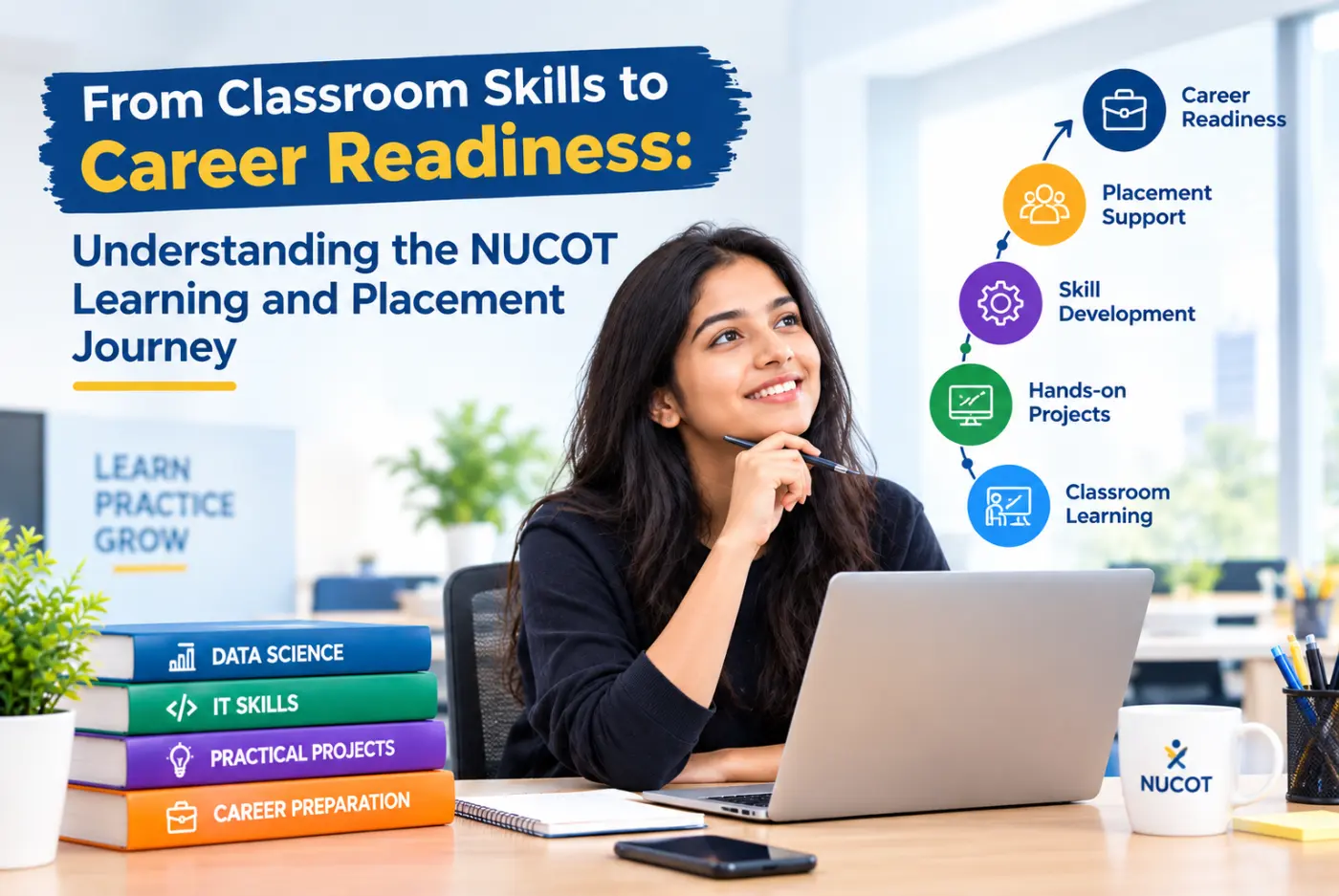
A useful way to understand placement support is to view it as a sequence.
Learning → Practice → Projects → Profile Building → Interview Preparation → Employer Interaction
Each stage contributes something different.
Technical training provides the foundation. Projects demonstrate application. Resume preparation helps communicate those skills. Mock interviews provide practice, while placement assistance can connect prepared candidates with relevant opportunities.
This distinction is particularly important for anyone researching Data Science training and job placement.
Building the Technical Foundation
Data Science is a multidisciplinary field.
A learner may need to understand Python programming, SQL, statistics, data analysis, visualization and machine learning. Modern programs may also introduce Generative AI and large language model concepts.
NUCOT’s Data Science and Generative AI training includes areas such as Python, SQL, machine learning, data visualization, Power BI, Tableau and Generative AI.
The purpose of learning these technologies is not simply to collect certificates.
The real value comes from understanding how they can be applied to solve business and analytical problems.
For example, SQL can be used to retrieve information from databases, Python can support data analysis and machine learning, while visualization tools can turn analytical findings into dashboards that decision-makers can understand.
Why Projects Influence Placement Readiness
Projects provide evidence that a candidate can apply technical concepts.
Consider a learner who has studied machine learning but has never worked with an actual dataset. During an interview, simply mentioning algorithms may not be enough.
A project changes the conversation.
The candidate can discuss the dataset, preprocessing, feature selection, model choice, evaluation metrics and final findings.
This gives recruiters a clearer understanding of the candidate’s practical ability.
For this reason, when reading NUCOT placement reviews, candidates should pay attention to whether discussions around career preparation include practical project experience.
Resume Preparation Is Part of the Process
Another stage that is sometimes underestimated is profile building.
A fresher may have completed several projects but still struggle to communicate them effectively on a resume.
A strong technical profile should make it easy for a recruiter to understand:
What does the candidate know?
What projects have they completed?
Which tools have they used?
What problems have they worked on?
What type of role are they seeking?
Career support can help candidates organise this information more effectively.
NUCOT’s placement-support approach includes resume/profile building and career guidance as part of its preparation process.
Mock Interviews Create a Different Kind of Learning
Technical learning and interview performance are different skills.
Someone may understand Python but become uncomfortable when asked to explain a programming problem verbally.
Another candidate may understand machine learning concepts but struggle to explain why a particular model was selected.
Mock interviews create an environment where these weaknesses can be identified before an actual employer interview.
They can also help candidates improve communication, project explanation and confidence.
For freshers, repeated practice can be particularly valuable because many have limited experience participating in professional interviews.
How Placement Assistance Fits In
Placement assistance should be understood as career support rather than a promise that every learner will receive an offer.
At NUCOT, the placement-support model focuses on areas such as career guidance, resume preparation, mock interviews and connecting prepared candidates with hiring opportunities.
The final result can depend on multiple factors, including technical skills, communication, interview performance, employer requirements and the candidate’s willingness to participate in opportunities.
This is an important point for anyone comparing AI/ML courses with placement.
The phrase “placement support” should lead to questions about what support is actually provided, rather than being treated as an automatic employment guarantee.
Looking at Placement Reviews More Carefully
When evaluating NUCOT placement reviews, candidates can look for specific information instead of relying on broad statements.
A useful placement story should ideally explain the candidate’s learning background, the type of preparation completed, the role involved and the career stage at which the opportunity occurred.
For example, NUCOT’s placement communications include candidate achievements and placement announcements. One such announcement highlights Varun’s placement at Peritas.
The value of such examples is strongest when they are presented as individual placement achievements rather than as evidence that every learner will receive the same result.
Training and Staffing: Why the Connection Matters
There is another aspect worth considering when evaluating NUCOT’s broader career ecosystem.
NUCOT positions itself across IT solutions, staffing and training. This creates a connection between technical skill development and the wider recruitment environment.
Training helps candidates develop skills.
Staffing and recruitment operate around employer requirements and available roles.
For a candidate, understanding this connection can make career preparation more practical. Instead of learning technologies in isolation, learners can think about how their skills relate to actual job descriptions and role expectations.
For example, someone targeting a Data Analyst role may need a different emphasis from someone targeting a Machine Learning Engineer position.
The career objective should therefore influence what the learner practices.
What Candidates Should Ask About NUCOT Placement
Before enrolling, candidates can ask:
How are candidates prepared for interviews?
Are projects included?
Is resume assistance provided?
Are mock interviews conducted?
How are suitable opportunities communicated?
What factors determine whether a candidate is considered for an opportunity?
What responsibilities remain with the learner?
These questions provide a clearer understanding of the placement process than simply asking whether an institute “provides placement.”
The Real Measure of Career Readiness
Career readiness is ultimately a combination of knowledge and execution.
A candidate who understands Python, SQL, machine learning and data visualization—but cannot explain their projects—may still struggle in interviews.
Likewise, a candidate with a polished resume but weak technical fundamentals may face difficulties during technical rounds.
The strongest preparation brings the two together.
That is why the relationship between training and placement is important when researching NUCOT reviews and NUCOT placement reviews.
The objective should be to develop a candidate who can learn, build, explain and interview—not simply complete a course.
Final Perspective
Placement should be viewed as the outcome of a larger preparation process.
For a Data Science learner, that process begins with technical foundations and continues through projects, profile development, mock interviews and career guidance.
NUCOT’s placement assistance is designed around these preparation stages, while individual outcomes naturally depend on the learner and the opportunities available.
Therefore, when evaluating NUCOT placement, look beyond the final result. Examine the journey that leads toward career readiness.
That approach provides a more realistic and useful understanding of what training and placement support can contribute to an IT career.