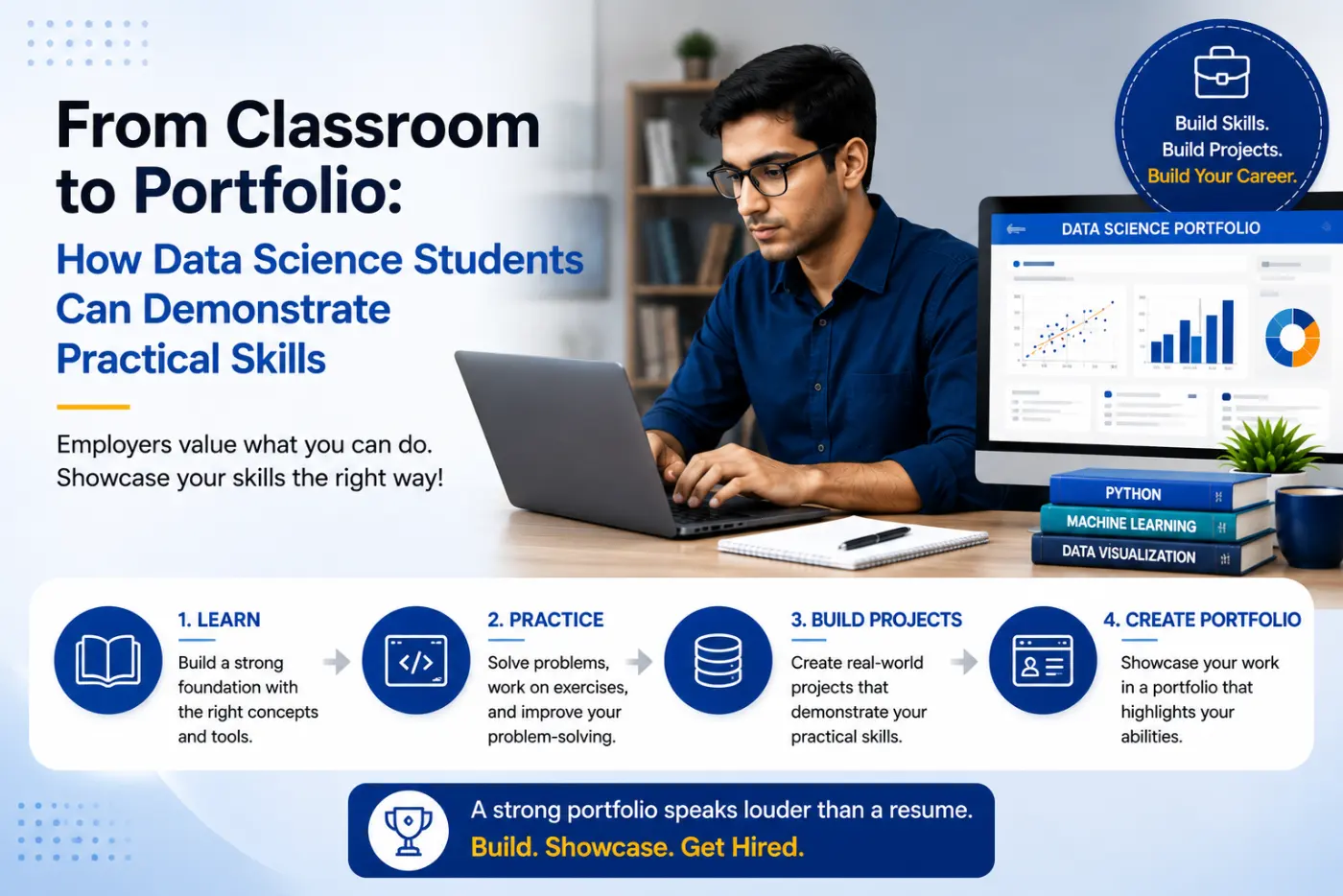
Learning Data Science involves much more than completing lessons and understanding technical concepts. For students preparing for a career in technology, one of the most important steps is learning how to demonstrate practical skills.
A classroom can provide the foundation. A portfolio can show how that knowledge is applied.
This is especially important for freshers who may not yet have professional experience. A well-developed portfolio can demonstrate familiarity with Python, SQL, data analysis, visualization, Machine Learning and project-based problem solving.
However, building a useful portfolio isn’t about collecting as many projects as possible. The real value comes from understanding the problem, explaining the approach and showing what was learned from the project.
Why Practical Skills Matter in Data Science
Data Science is an applied field. Professionals rarely work with perfectly prepared datasets or questions that have an obvious answer.
A typical project may involve collecting information, cleaning the data, exploring patterns, creating visualizations, selecting an appropriate model and communicating the results.
This means students need to develop more than theoretical knowledge.
For example, knowing what a classification algorithm does is useful. Being able to determine when classification is appropriate, prepare the data, evaluate the model and explain its limitations is much more valuable.
A portfolio provides an opportunity to demonstrate this difference.
Start With a Problem, Not a Technology
One common mistake beginners make is selecting a technology first and then searching for something to build with it.
A stronger approach is to begin with a question.
Instead of saying, “I want to build a Python project,” a student could ask:
Can customer behaviour be analysed to identify factors associated with customer retention?
Instead of simply creating a Machine Learning model, the project could investigate whether historical information can be used to predict a particular outcome.
Starting with a problem gives the project a clear direction.
It also makes the final portfolio easier to explain during an interview.
Build a Strong Foundation With Python
Python is one of the most commonly used programming languages in Data Science.
Students should become comfortable with basic programming concepts before immediately moving into advanced libraries.
Variables, conditions, loops, functions, data structures and error handling provide the foundation.
Once those concepts are familiar, Python can be used for data manipulation, analysis and visualization.
A portfolio project could demonstrate how Python was used to clean a dataset, identify patterns and generate useful insights.
The important part is not simply displaying the code. Students should explain why particular steps were taken.
Don’t Ignore SQL
Data Science training in bangalore with placement students sometimes focus heavily on Python while giving less attention to SQL.
In professional environments, however, data often exists in relational databases.
SQL allows analysts and Data Scientists to retrieve, filter, combine and summarize information.
A portfolio can include a small database project showing queries for customer analysis, sales performance or product information.
Rather than uploading a collection of unrelated queries, students can organize them around business questions.
For example:
Which products generated the highest revenue?
Which customer groups contributed the most sales?
How did performance change over different periods?
This approach demonstrates both technical ability and analytical thinking.
Show Your Data Cleaning Process
Real-world data can be messy.
Datasets may contain missing values, duplicate records, inconsistent formats or unusual observations.
A strong project should therefore show how the student approached data preparation.
Instead of simply presenting a cleaned dataset, explain what problems were discovered and how they were handled.
For example, if several records contain missing values, the student could explain whether those records were removed, replaced or retained and why.
These decisions demonstrate practical understanding.
Use Exploratory Data Analysis to Find Patterns
Exploratory Data Analysis, or EDA, is an important stage of many Data Science projects.
The objective is to understand the data before building a predictive model.
Students can investigate distributions, relationships between variables, unusual observations and potential trends.
Visualization can make this process easier.
Charts and graphs can reveal patterns that may not be immediately visible in a table.
A portfolio becomes more useful when the student explains what each important visualization shows rather than simply adding numerous charts.
Turn Analysis Into a Story
A good Data Science and gen ai training in bangalore portfolio should be understandable even to someone who isn’t deeply technical.
Consider the difference between:
“Used Pandas and Scikit-learn to build a model.”
and:
“Analysed customer information to identify factors associated with churn and developed a classification model to estimate customer retention risk.”
The second explanation gives the reader a reason to care about the project.
Students should therefore structure projects around a simple story:
What was the problem?
What data was available?
What did the analysis reveal?
What approach was used?
What were the results?
What could be improved?
This structure can make technical work considerably easier to understand.
Machine Learning Projects Should Have a Purpose
Machine Learning can make a portfolio interesting, but using an advanced algorithm doesn’t automatically make a project impressive.
The project should solve a meaningful problem.
A student could explore sales forecasting, customer classification, price prediction or another appropriate use case.
The important part is understanding the complete workflow.
This includes preparing the data, selecting features, dividing the dataset, choosing a model and evaluating its performance.
Students should also understand that a model’s accuracy doesn’t tell the entire story.
Depending on the problem, precision, recall, F1 score, mean absolute error or other metrics may be more appropriate.
Being able to explain why a particular metric was selected can demonstrate stronger understanding.
Create Fewer but Better Projects
A portfolio doesn’t need twenty projects.
Three or four well-developed projects can be more useful than a large collection of copied tutorials.
A balanced portfolio could include an analytics project, a SQL-based project, a visualization project and a Machine Learning project.
Each should demonstrate a different skill while still fitting into the student’s overall career direction.
Quality also makes preparation easier.
If an interviewer asks about a project, the student should be able to explain the data, methodology, challenges and results confidently.
Document What You Learned
Documentation is often overlooked.
A project should include a clear introduction, explanation of the dataset, methodology and results.
Students can also mention challenges they encountered.
Perhaps a model initially performed poorly.
Perhaps missing data affected the analysis.
Perhaps a particular feature had to be removed.
Explaining these experiences demonstrates that the project wasn’t simply copied from a tutorial.
It shows the learning process.
Use GitHub or Another Portfolio Platform
Students can make their projects accessible through an online portfolio.
GitHub can be useful for sharing code, notebooks and documentation.
A portfolio website can provide a more visual presentation.
The platform itself is less important than the quality and organization of the material.
Each project should have a clear title and short description so visitors immediately understand what it demonstrates.
Connect Projects With Your Career Goal
A portfolio should support the career direction you are pursuing.
Someone interested in Data Analytics might focus more on SQL, Excel, Power BI and business dashboards.
A student targeting Data Science roles may emphasize Python, statistics, Machine Learning and analytical projects.
Someone interested in Artificial Intelligence might gradually include NLP, Deep Learning or Generative AI applications.
This doesn’t mean students need to specialize immediately. It simply helps create a more coherent professional profile.
How Students Can Evaluate Training Programs
Students researching training institutes may encounter different opinions online, including NUCOT Reviews, placement-related discussions and experiences shared by other learners.
Reviews can be useful when researching a training program, but they should be considered alongside the actual curriculum, project structure, learning format and career preparation.
A prospective student should ask whether the program provides opportunities to practise what is being taught.
The same principle applies regardless of the institute selected: students ultimately need to develop and understand their own skills.
Prepare to Explain Your Portfolio
Building the portfolio is only half the process.
Students should also practise explaining their projects.
An interviewer may ask why a particular dataset was selected, why one model performed better than another or what limitations the project had.
Being prepared for these questions can turn a portfolio from a collection of files into evidence of genuine learning.
Try explaining each project in two versions.
First, explain it in simple language for a non-technical person.
Then explain the technical implementation to someone familiar with Data Science.
This exercise can improve both communication and interview confidence.
Keep Improving the Portfolio
A portfolio should not be treated as a finished product.
As students learn new techniques, they can revisit older projects and improve them.
A visualization can be redesigned.
A model can be compared with another approach.
Documentation can be improved.
Additional insights can be added.
This demonstrates continuous learning, which is particularly valuable in a rapidly changing technology field.
Final Thoughts
Moving from the classroom to a professional Data Science career requires more than completing a syllabus.
Students need opportunities to apply concepts, solve problems and communicate what they have learned.
Python, SQL, statistics, data visualization and Machine Learning can provide the technical foundation. Projects then bring those skills together.
For freshers, a strong portfolio can provide tangible evidence of practical ability even before they have professional experience.
The goal shouldn’t be to create the largest portfolio. It should be to create a credible portfolio that reflects genuine understanding.
When every project has a clear problem, logical methodology, meaningful results and an honest explanation of what was learned, the portfolio becomes more than a collection of assignments it becomes a practical representation of the student’s Data Science journey.