Starting a career in Data Science can seem confusing for a beginner. There are many technologies to learn, different job roles to consider, and hundreds of courses available in the market. A student may start by searching for a data science course in Bangalore, only to find programs covering Python, SQL, Machine Learning, Artificial Intelligence, Generative AI, analytics, and several other technologies.
The good news is that beginners do not need to learn everything at once.
A better approach is to follow a structured roadmap, starting with programming fundamentals and gradually moving toward data analysis, Machine Learning, Artificial Intelligence, and practical projects.
For students and career switchers in Bangalore, understanding this progression can make it easier to choose suitable training and prepare for entry-level opportunities.
Step 1: Start With Python
Python is one of the most useful starting points for someone interested in Data Science.
A beginner does not need to become an advanced software developer before starting Data Science. However, understanding basic programming concepts is important.
These include variables, data types, conditional statements, loops, functions, lists, dictionaries, file handling, and basic object-oriented programming.
Once these fundamentals are understood, Python can be applied to data-related tasks.
This is where a Python for Data Science course in Bangalore can be useful. Instead of learning Python only as a programming language, students can learn how to use it for data manipulation, analysis, automation, and Machine Learning.
The goal should be to develop problem-solving ability rather than simply memorising syntax.
Step 2: Learn SQL and Databases
After Python, SQL is another important skill for aspiring Data Science and Analytics professionals.
Most organisations store large amounts of information in databases. Professionals need to retrieve the right information before analysing it.
A SQL course in Bangalore should ideally cover practical concepts such as:
- Selecting and filtering data
- Sorting and grouping information
- Aggregate functions
- Joins
- Subqueries
- Data manipulation
- Working with multiple tables
Understanding SQL gives students a better idea of how business data is actually accessed.
Python and SQL also complement each other. SQL can be used to retrieve information from a database, while Python can then be used for deeper analysis and modelling.
Step 3: Understand Statistics
Statistics is often overlooked by beginners because students are more attracted to AI and Machine Learning.
However, statistics provides an important foundation for Data Science.
Learners should understand concepts such as averages, distributions, probability, variance, correlation, sampling, and basic statistical testing.
The purpose is not to memorise mathematical formulas.
Instead, students should understand what the numbers mean and how they can influence decisions.
For example, if two variables appear to be related, statistical concepts can help determine whether the relationship is meaningful or simply coincidental.
This type of analytical thinking becomes increasingly important when working with real-world datasets.
Step 4: Learn Data Analysis
Once Python, SQL, and basic statistics are in place, learners can move into data analysis.
Data analysis involves understanding datasets, identifying patterns, finding inconsistencies, and generating useful insights.
Students can learn how to clean datasets, handle missing values, identify outliers, transform information, and perform exploratory analysis.
Python libraries commonly used for data analysis can make this process more efficient.
This stage is important because Machine Learning models depend heavily on the quality of the data provided to them.
A learner who understands data preparation will have a stronger foundation for later Machine Learning work.
Step 5: Learn Data Visualisation
Finding an insight is only part of the job.
A Data Science professional also needs to communicate that insight clearly.
Data visualisation helps turn complex datasets into charts, graphs, dashboards, and other easily understandable formats.
Students may work with Python-based visualisation libraries or business intelligence tools depending on their career path.
For example, a sales dataset can be transformed into a dashboard showing revenue trends, product performance, customer segments, or regional differences.
These skills are useful not only for Data Scientists but also for Data Analysts and Business Intelligence professionals.
This is one reason learners comparing the best data analytics course in Bangalore should examine whether the curriculum includes practical data analysis and visualisation rather than focusing only on theoretical concepts.
Step 6: Move Into Machine Learning
Once students understand how to work with data, they can begin learning Machine Learning.
Machine Learning allows systems to identify patterns in data and make predictions or classifications.
Beginners may start with concepts such as:
- Supervised learning
- Unsupervised learning
- Regression
- Classification
- Clustering
- Feature engineering
- Model evaluation
The important part is understanding how these techniques are used to solve problems.
For example, a company might want to predict customer churn. A student could use historical customer data to develop a model that identifies patterns associated with customers leaving.
Practical examples like this make Machine Learning easier to understand than learning algorithms only through theory.
Step 7: Explore Artificial Intelligence
After gaining experience with Data Science and Machine Learning, students can explore Artificial Intelligence more broadly.
The demand for artificial intelligence training in Bangalore has increased as businesses experiment with automation, intelligent applications, and AI-powered solutions.
Artificial Intelligence covers a broad range of applications.
Depending on the learner’s interests, this may include Machine Learning, Natural Language Processing, computer vision, intelligent automation, and Generative AI.
Students should not feel pressured to learn every AI technology immediately.
A strong foundation in programming, data, and Machine Learning provides a better base for exploring advanced AI concepts.
Step 8: Understand Generative AI
Generative AI has become one of the fastest-growing areas of technology.
It enables AI systems to generate content such as text, code, images, summaries, and other outputs.
For beginners, learning Generative AI can include understanding how large language models work at a conceptual level, prompt design, AI-assisted development, document processing, and building applications that use AI capabilities.
However, Generative AI should not be viewed as a replacement for Data Science fundamentals.
A student who understands Python, SQL, statistics, and Machine Learning can better understand where Generative AI fits into a larger technology ecosystem.
This is why modern software training institutes in Bangalore are increasingly incorporating AI-related technologies into broader technical learning paths.
Step 9: Build Practical Projects
Learning concepts is important, but projects are where those concepts begin to make sense.
A beginner can start with relatively simple projects and gradually increase the complexity.
For example:
Beginner:
Analyse a sales dataset using Python.
Intermediate:
Build a customer segmentation project.
Advanced:
Develop a Machine Learning model for customer churn prediction.
AI-focused:
Create a Generative AI application that works with documents or business information.
Projects allow students to combine multiple skills.
A single Data Science project might involve Python, SQL, statistics, data cleaning, visualisation, Machine Learning, and model evaluation.
This also gives students something concrete to discuss during interviews.
Step 10: Consider Data Science On-the-Job Training
Classroom learning provides structure, but professional environments involve different challenges.
This is where data science on the job training can be particularly useful when available.
Working on practical assignments, simulated business problems, internships, or supervised projects can help learners understand how technical skills are applied outside the classroom.
Students should look for opportunities to work with realistic datasets and business scenarios.
The objective should be to move from:
Learning concepts → Applying concepts → Solving problems → Explaining solutions
That progression can make a significant difference when preparing for a professional role.
What About Placement Support?
Placement is an important consideration for many students.
Searches for data science training with placement, data science training and job placement, and even best data science course with placement guarantee are common among people comparing institutes.
However, students should understand the difference between placement assistance and guaranteed employment.
Career support may include resume development, mock interviews, portfolio guidance, interview preparation, career counselling, and information about relevant opportunities.
These services can improve a candidate’s preparation, but employers ultimately decide whom they hire.
A student should therefore focus first on developing strong technical skills.
The combination of technical ability + practical projects + interview preparation + career guidance is more useful than relying on a placement statement alone.
Online or Offline: Which Learning Format Is Better?
Bangalore students have access to both online and classroom-based learning.
Online learning can be useful for working professionals or students who need flexibility.
Offline learning can be beneficial for learners who prefer direct interaction with trainers and classmates.
Neither format is automatically better.
The important factors are the quality of instruction, practical exposure, trainer interaction, doubt-clearing support, project guidance, and the student’s ability to remain consistent.
Someone searching for online AI and Machine Learning courses for beginners may prefer the flexibility of remote learning, while another learner may benefit more from a structured classroom environment.
How Long Does It Take to Become Job-Ready?
There is no fixed timeline that applies to everyone.
A graduate with programming experience may progress faster than someone starting from zero.
Instead of focusing only on the number of weeks or months, beginners should focus on what they can actually do.
A learner can consider themselves better prepared when they can:
- Write Python programs independently
- Query databases using SQL
- Clean and analyse datasets
- Explain basic statistical concepts
- Create useful visualisations
- Build and evaluate Machine Learning models
- Complete practical projects
- Explain their projects during an interview
These are more meaningful indicators of progress than simply completing a syllabus.
Career Options After Learning Data Science
Data Science is not limited to one job title.
Depending on their skills and interests, learners may explore roles such as:
Data Analyst — focuses on analysing data and generating business insights.
Junior Data Scientist — works with datasets, statistical methods, and Machine Learning models.
Machine Learning Engineer — focuses more heavily on developing and deploying Machine Learning solutions.
AI Developer — works on applications that use Artificial Intelligence technologies.
Business Intelligence Analyst — focuses on reporting, dashboards, and data-driven decision-making.
Understanding these roles can help students choose the right learning path.
Someone interested primarily in dashboards and business reporting may focus more on Analytics, while someone interested in predictive modelling may move toward Data Science and Machine Learning.
Why Bangalore Is a Popular Location for Data Careers
Bangalore has a large technology ecosystem consisting of established technology companies, startups, product organisations, consulting firms, and businesses adopting AI and analytics.
This creates an environment where professionals with Data Science and AI skills can explore different career paths.
However, being located in Bangalore does not automatically guarantee employment.
Students still need to develop relevant skills, create projects, build a professional profile, and prepare for interviews.
The advantage of learning in a major technology hub is the exposure to a broader technology ecosystem and professional opportunities.
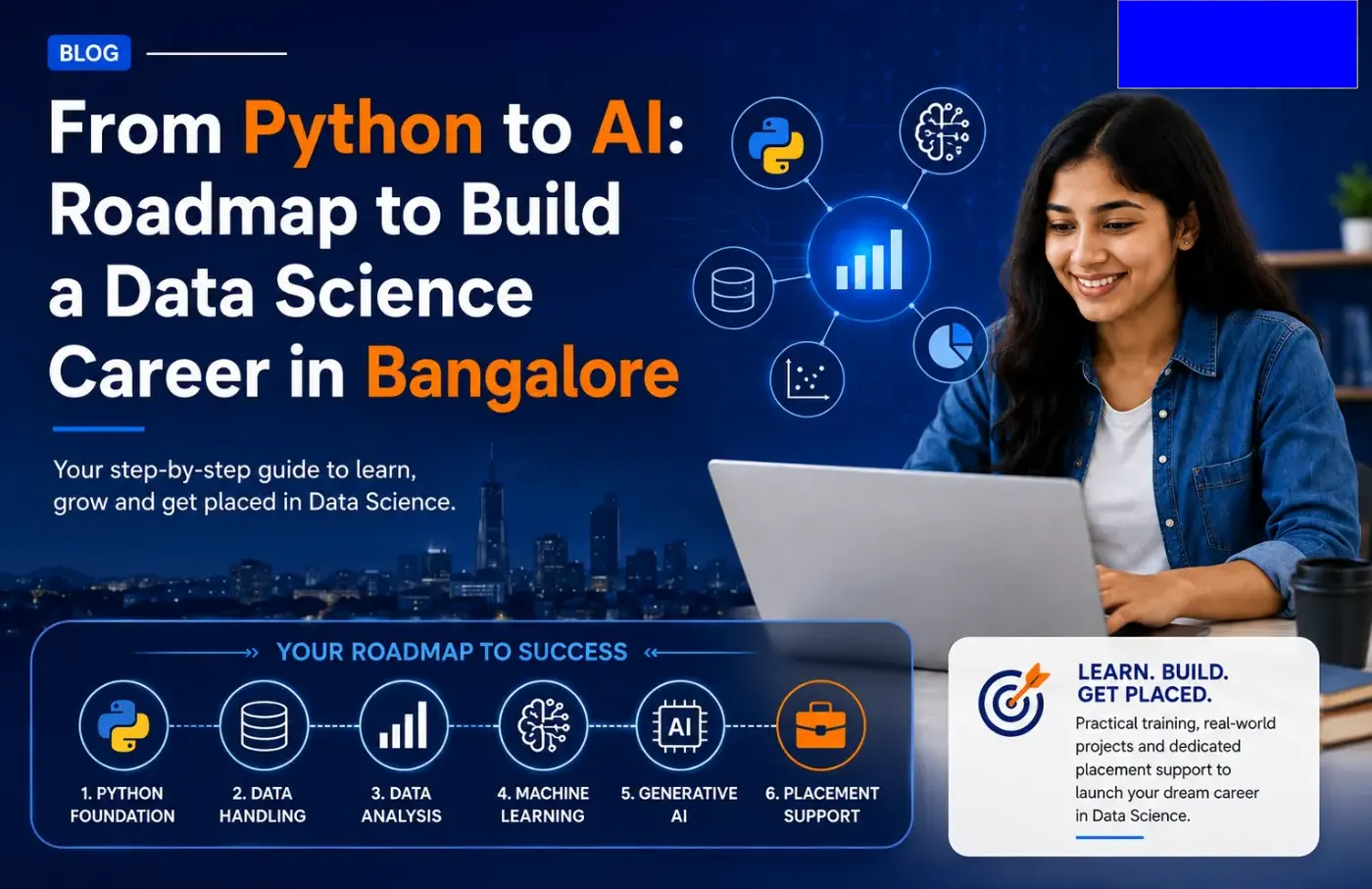
Final Roadmap for Beginners
A beginner does not need to learn everything simultaneously.
A practical progression can look like this:
Each stage builds on the previous one.
Students looking for data science courses in Bangalore should therefore compare programs based on whether they provide a structured path through these areas.
The right training can provide guidance and structure, but the learner’s own practice remains essential.
Final Thoughts
Building a Data Science career is a gradual process.
Python provides the programming foundation. SQL helps learners work with databases. Statistics supports analytical thinking. Data Analysis and visualisation turn raw information into insights. Machine Learning introduces predictive modelling, while Artificial Intelligence and Generative AI open up newer applications.
For beginners in Bangalore, the goal should not be to learn every technology as quickly as possible.
Instead, build strong fundamentals, practise regularly, complete meaningful projects, understand different career roles, and prepare for interviews.
Whether you choose a Data Science course in Bangalore, an AI program, or a broader technology training path, focus on the skills you can actually demonstrate.
A strong career roadmap is not about collecting the maximum number of technologies. It is about developing the ability to understand a problem, work with data, use the right technology, build a solution, and explain your approach clearly.