Data Science has become an important area of technology, helping businesses analyse information, identify patterns, improve decisions and develop intelligent applications. As artificial intelligence continues to evolve, learners are increasingly exploring how Python, data analytics, machine learning and Generative AI fit together.
For students and professionals considering a Data Science course in Bangalore, understanding the learning sequence is just as important as choosing the right institute. Learning individual tools without understanding how they connect can make it difficult to solve real business problems.
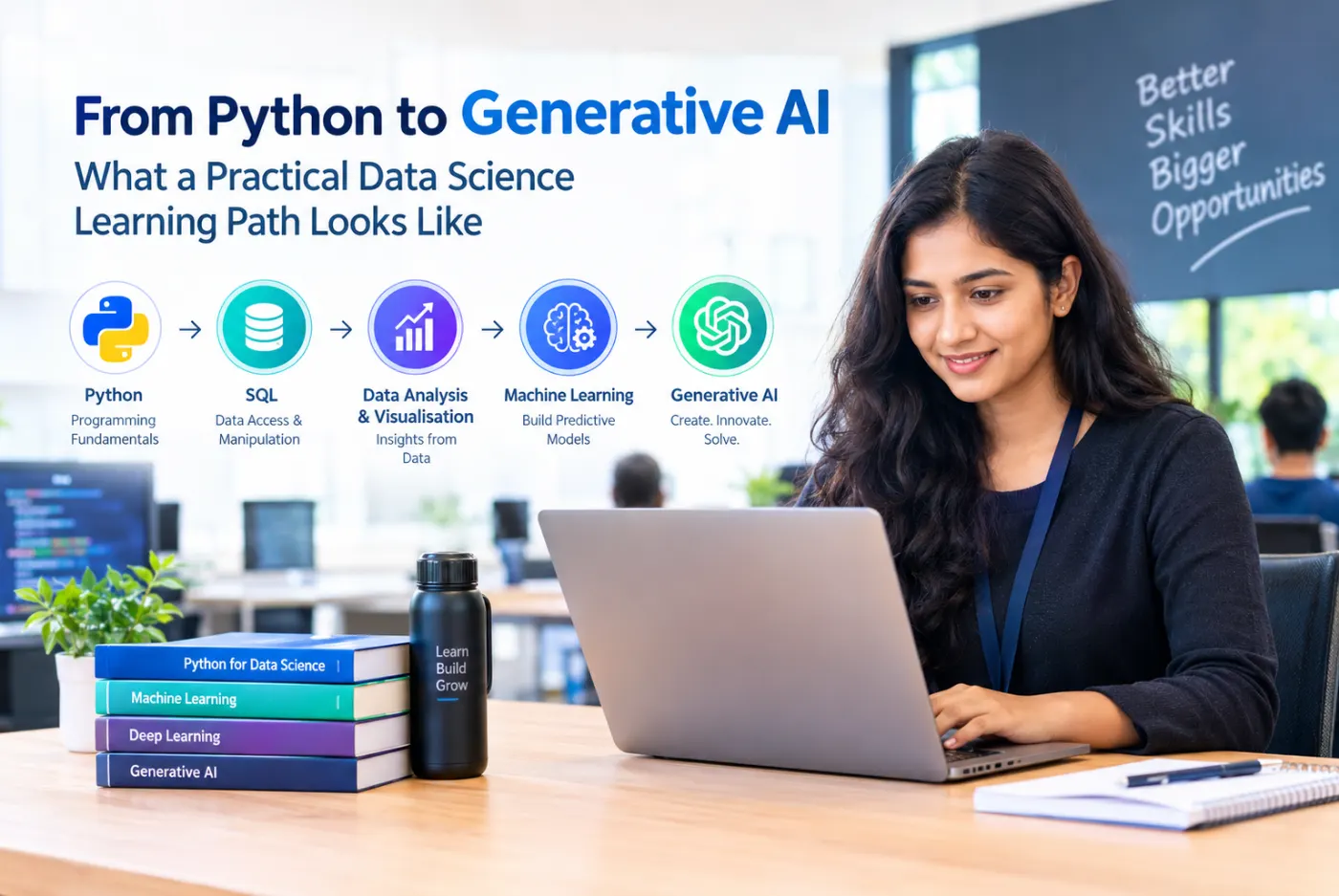
A practical learning path begins with programming fundamentals, progresses through data handling and statistical analysis, and then introduces machine learning and Generative AI. At NUCOT, this progression aligns with the broader focus on Data Science, AI, ML and emerging technologies.
Why Python Is a Foundation for Data Science
Python is widely used in Data Science because its readable syntax and extensive libraries make it useful for data manipulation, analysis, visualisation and machine learning. Beginners can start with programming fundamentals before progressing to more advanced applications.
A structured Python for Data Science course in Bangalore should help learners understand variables, data types, conditional statements, loops, functions, lists, dictionaries and file handling. These concepts form the foundation for writing scripts and working with datasets.
Libraries such as NumPy and Pandas support numerical operations and data manipulation. Matplotlib and Seaborn can be used to create visualisations that reveal patterns and trends.
For example, a learner analysing monthly sales data may use Python to identify the best-performing products, compare regional performance and examine changes over time. The objective is not simply to write code but to use programming to answer meaningful questions.
Building Analytical Skills with SQL and Statistics
Once learners understand Python fundamentals, the next step is learning how to access, organise and interpret data.
SQL is important because many organisations store business information in relational databases. Learners should practise retrieving records, filtering results, joining tables, grouping information and calculating aggregates.
Statistics adds another layer of understanding. Concepts such as averages, distributions, variance, probability, correlation and sampling help learners interpret datasets more carefully. Without statistical knowledge, it is easy to mistake coincidence for a meaningful relationship or draw conclusions from incomplete information.
A practical Data Science curriculum should combine these skills through exercises. For instance, learners could analyse customer orders, calculate average purchase values, compare customer segments and identify trends that require further investigation.
This foundation is particularly useful for students exploring Data Science training in Bangalore, because employers often expect candidates to explain both the process they followed and the reasoning behind their conclusions.
Data Cleaning, Exploration and Visualisation
Real-world data is rarely perfect. It may contain missing values, duplicate records, inconsistent formats or unusual observations. Before building a model, learners need to understand how to inspect and prepare the information.
Exploratory Data Analysis, commonly called EDA, helps identify patterns, relationships, outliers and possible data-quality problems. Visualisations can make these findings easier to understand and communicate.
Learners can practise using Pandas to clean datasets, calculate summary statistics and prepare information for analysis. They can then create charts and dashboards using appropriate visualisation tools.
Power BI and Tableau are useful options for presenting business information interactively. A dashboard might show sales performance, monthly revenue, customer behaviour or operational trends.
These exercises help learners move from simply knowing programming syntax to explaining what a dataset reveals and how the findings might support a business decision.
Moving from Data Analysis to Machine Learning
Machine Learning introduces techniques that allow computers to identify patterns in data and make predictions or classifications. It builds on programming, data preparation and statistical reasoning.
A structured machine learning course in Bangalore should introduce core concepts such as supervised learning, unsupervised learning, model training, testing and evaluation. Learners can explore algorithms such as linear regression, decision trees, clustering and classification, depending on the curriculum.
For example, a business might want to estimate future sales or identify customers who may stop using a service. Learners can explore how historical data can be used to develop a model, evaluate its performance and understand its limitations.
It is equally important to learn about overfitting, data leakage, model evaluation and the difference between training performance and performance on unseen data. These concepts encourage learners to approach predictions critically instead of assuming that every model produces reliable results.
Projects provide an opportunity to apply these ideas. A learner might build a price prediction model, analyse customer segments or develop a classification project using a publicly available dataset.
Understanding Artificial Intelligence and Generative AI
Artificial Intelligence is a broad field that includes methods for building systems capable of tasks such as prediction, classification, language processing and decision support. Machine Learning is one of the approaches used within AI.
Generative AI focuses on systems that generate content such as text, images, summaries and code. Large Language Models, or LLMs, are an important part of this ecosystem.
Learners exploring a Gen AI course in Bangalore can benefit from understanding how these systems work at a practical level. Relevant topics may include prompt design, model capabilities, output evaluation, responsible use and applications in business workflows.
For example, a learner could explore using an LLM to summarise a report, extract structured information from text or help create a first draft of a business document. The results still require review because generative systems can produce inaccurate or unsupported information.
A broader Data Science and Gen AI course should connect these tools to the foundations of data handling, analytical reasoning and programming rather than treating Generative AI as a replacement for those skills.
Why Practical Projects Matter
A learning path becomes more valuable when learners apply each stage to a problem. Projects help demonstrate how programming, analysis, modelling and communication work together.
A portfolio could include a cleaned dataset with an EDA report, an interactive Power BI dashboard, a machine learning model and a small Generative AI application. Each project should explain the problem, data sources, methods used, results and limitations.
This also helps candidates prepare for interviews. They should be able to explain why they selected a method, how they evaluated the result and what they would improve if they had more time or better data.
When comparing Data Science courses in Bangalore with placement, learners should look beyond the course title and ask whether the program offers structured project work, feedback, portfolio guidance and interview preparation. Placement assistance can support career preparation, but employment outcomes depend on individual skills, performance and employer requirements.
Choosing a Learning Path with NUCOT
NUCOT works across IT training, Data Science, AI, Machine Learning and Generative AI. Learners considering a Data Science course in Bangalore can review the current curriculum, training format, practical exercises and career-support details to determine whether the program matches their goals.
Before enrolling, ask how the course progresses from Python and SQL to analytics, machine learning and Generative AI. Check the amount of hands-on work, the tools covered, the feedback available on projects and the expectations for independent practice.
Learners should also consider their starting point. Beginners may need more time to build programming and mathematical foundations, while working professionals may focus on applying analytics or AI to a particular industry.
Conclusion
The journey from Python to Generative AI is best approached as a sequence of connected skills. Programming builds the foundation, SQL and statistics strengthen analytical reasoning, data visualisation improves communication, and Machine Learning introduces predictive methods. Generative AI then adds new ways to work with language, information and content.
For anyone exploring Data Science training in Bangalore, a practical learning path should prioritise understanding, project work and responsible application not just the number of technologies listed in a syllabus. Choosing a program that connects these stages can help learners build skills they can demonstrate and continue developing as the field evolves.