
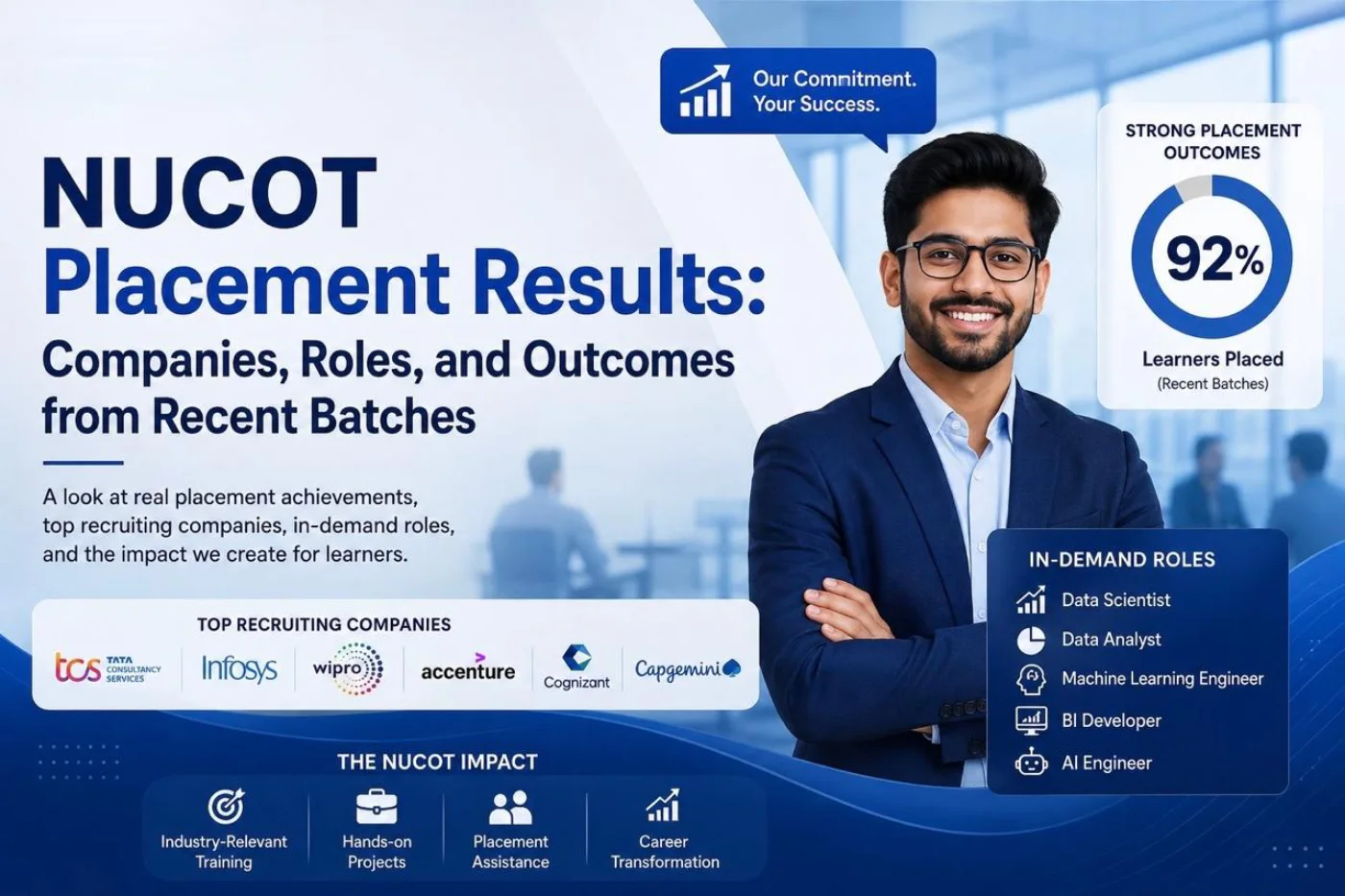
Choosing a data science training institute in Bangalore usually comes down to one question that’s hard to answer from a website alone: do people who complete this course actually get hired, in real roles, at real companies?
Almost every institute answers that question with a percentage on a landing page “100% placement assistance,” “95% success rate,” and similar phrases appear across nearly every training provider in the city. On their own, these numbers don’t tell a prospective student much, because there’s no visibility into how they’re calculated, over what time period, or against what denominator.
We think a placement claim is only meaningful if you can see how it’s tracked and what sits behind it. This post walks through NUCOT’s actual placement process, how we measure outcomes batch by batch, and the real results from recent cohorts with specifics, not just a headline stat.
Why Placement Numbers Are So Easy to Misread
Before getting into our own data, it’s worth understanding why placement statistics across the industry are so hard to compare directly.
A “95% placement rate” can mean very different things depending on:
- Whether it’s measured against everyone who enrolled, or only against everyone who completed the course
- Whether it includes internships and short-term contract roles alongside full-time offers
- Whether it’s a rolling average across several years, or reported per individual batch
- Whether “placement” means an interview was arranged, or an offer letter was actually signed
None of these framings are necessarily dishonest but they produce very different real-world outcomes for a student, and most institutes don’t specify which definition they’re using. We want to be explicit about ours.
How NUCOT Actually Tracks Placement Success
We measure the following per batch cohort, not blended across multiple years:
- Course completion rate: how many enrolled students finish the full curriculum, including the capstone project and portfolio submission. Placement support only begins once this stage is reached.
- Interview readiness rate: how many completing students pass through our mock interview and resume/portfolio review process and are marked ready to be referred externally.
- Placement rate within a defined window: tracked as offers signed within a set number of months of reaching interview-ready status, reported per batch so one strong quarter can’t mask a weaker one, and one weak quarter can’t be hidden inside a multi-year average.
- Time-to-offer: the typical gap between becoming interview-ready and receiving a first offer.
- CTC range at placement: reported as a real spread across a batch, not a single average that flattens out how wide actual outcomes can be.
Our 5-Step Placement Process
Placement support at NUCOT isn’t a single event that happens after the course ends it’s built into the program structure from week one, running alongside the technical curriculum rather than following it.
- Course Completion Optimisation. Every student is tracked through the full 45-day curriculum, including live client-style projects and the capstone build, before entering the placement pipeline. We don’t push students into interviews before they’re technically ready, because a rushed placement is a worse outcome for everyone than a slightly delayed one.
- Career Assessment. A one-on-one session maps each student’s strengths, prior background, and realistic role targets: Data Analyst, Machine Learning Engineer, Business Intelligence Analyst, AI Engineer, and so on. This step exists because “get a data science job” isn’t a single target; the right first role differs a lot between a fresh graduate and a career switcher from a non-IT background.
- Portfolio & Resume Building. Every student leaves with a recruiter-facing resume and a GitHub portfolio built from actual capstone project work, not a generic template listing course modules completed. Hiring partners consistently tell us this is what gets a candidate shortlisted over a resume that just lists a certificate.
- Mock Interviews. Technical and HR-round mock interviews are repeated as many times as a student needs, not capped at a single attempt. Interview coaching includes real feedback after each round, not just a pass/fail outcome.
- Hired. Interview-ready students are referred directly into our hiring partner network, followed by 30 days of post-placement mentorship because the first month in a new data role is often where a placement either sticks or falls apart, and we’d rather stay involved through that period than treat “hired” as the finish line.
Roles Our Students Have Landed
Based on our placement data across recent batches, graduates of the Data Science with Python & Gen AI program have gone on to roles including:
- Data Analyst
- Data Scientist
- Machine Learning Engineer
- Business Intelligence Analyst
- AI Engineer / AI Developer
- Data Engineer / Data Architect
- Deep Learning Engineer
- GenAI Specialist / NLP Engineer
- AI Consultant


Typical CTC at placement ranges from ₹4.5–9 LPA, depending on prior experience, role complexity, and the hiring company. We report this as a range rather than a single average figure, because doing so more honestly reflects how wide the actual spread of outcomes is across a batch of students with different starting points.
What to Ask Any Institute Before You Enroll
Whether you’re evaluating NUCOT or comparing several institutes, these are fair, specific questions worth asking before you commit:
- Is the placement rate tracked per batch, or blended across several years of data?
- Does the stated rate include internships and short-term contracts, or only full-time offers?
- What happens if a student isn’t placed within the stated timeframe? Is there continued support, or does assistance end at a fixed point?
- Can the institute show real, verifiable outcomes a name, a company, a role rather than only anonymized testimonials?
- Is there a cost difference between general “placement assistance” and anything closer to a placement guarantee, and what exactly does each include?
We’re glad to walk through our own batch-level numbers in detail during a free demo class, including recent placement data for the specific program you’re considering not just the headline rate, but how it was measured.
Why We’re Publishing This
Most institutes treat placement statistics as a marketing line rather than something a prospective student can actually examine. We’d rather be the exception. Publishing the methodology behind our numbers not just the numbers themselves, means a student can genuinely evaluate whether NUCOT is the right fit, instead of taking a headline percentage on faith.
This also means holding ourselves to a standard that’s checkable. If a batch’s placement rate is lower in a given quarter because of market conditions, seasonal hiring slowdowns, or a smaller cohort of interview-ready students, that should show up in batch-level reporting rather than being smoothed over by a multi-year average. We’d rather a prospective student see an honest, sometimes uneven picture than a single polished number that doesn’t reflect how outcomes actually vary batch to batch.
Where Outcomes Depend on the Student, Not Just the Institute
It’s also worth being direct about something training providers rarely mention: placement outcomes are a partnership, not something an institute delivers unilaterally. A student who completes every assignment, engages seriously with mock interviews, and builds a genuine capstone project is in a very different position than one who completes the minimum required to receive a certificate. Our process is designed to push every student toward the former, but the range of CTC outcomes and time-to-offer we report reflects that some students start from stronger positions before technical background, communication skills, and how much practice they put into interview prep than others.
This is part of why we report ranges instead of single averages. A ₹4.5–9 LPA spread means exactly what it says: outcomes vary meaningfully depending on the student and the role, not that everyone lands the same package.
The Bigger Picture
No training institute NUCOT included places every single enrolled student, and any claim that suggests otherwise is worth treating with some skepticism. What we can commit to is transparency about how our numbers are actually calculated, a placement process that runs through the entire course rather than starting after it ends, and a willingness to show real outcomes rather than only aggregate percentages.
If you’re comparing data science training institutes in Bangalore, we’d encourage you to ask every one of them the questions above, including us. A serious institute should be able to answer all five without hesitation, and should welcome the questions rather than deflect them.