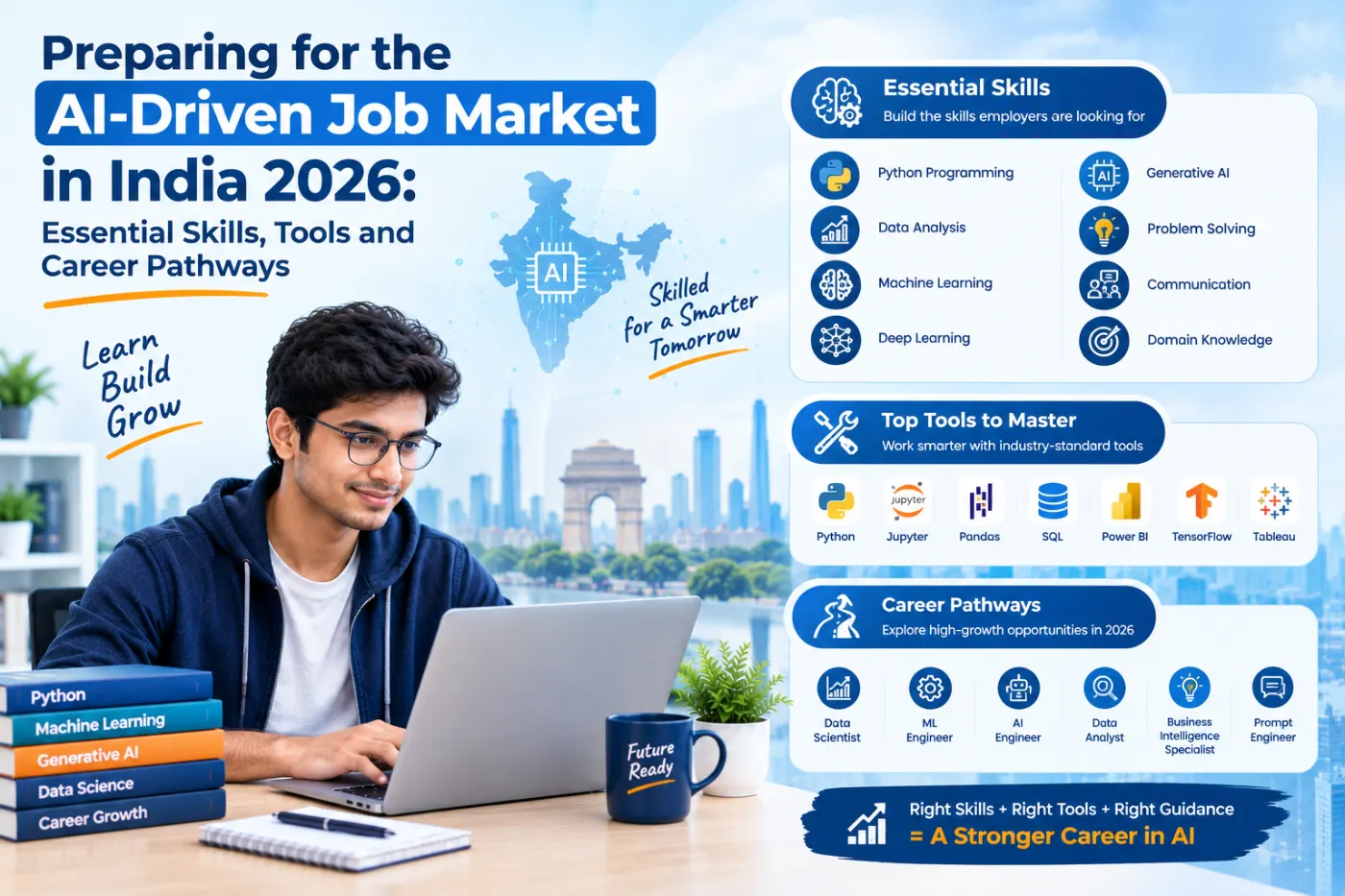
Artificial Intelligence is changing how businesses analyse information, automate tasks and develop digital products. From customer support and financial services to healthcare and software development, organisations are exploring AI applications to improve productivity and decision-making.
As these technologies become part of everyday business operations, students and working professionals are asking an important question: Which skills should I learn to prepare for the AI-driven job market in India in 2026?
The answer is not limited to learning one AI tool. A strong foundation in programming, data analytics, machine learning, cloud technologies and problem-solving can help learners understand how AI systems work and where they can be applied.
For anyone considering Data Science training in Bangalore, this guide explains the skills, technologies and practical learning approaches worth exploring.
1. Understand How AI Is Changing the Indian Job Market
AI is influencing both new and existing technology roles. Businesses are adopting tools that support data analysis, content generation, workflow automation and software development.
India’s AI skills landscape is also evolving. The NIIT India Skills Gap Report 2026 identifies AI, cybersecurity, digital and data skills as important future capabilities. A separate Quess Corp report has highlighted shortages in specialised areas such as Generative AI, AI deployment engineering and MLOps. These reports indicate a growing need for practical skills, although hiring requirements differ across employers and roles.
Bengaluru is an important technology and AI employment hub. This makes local learning opportunities relevant for students exploring technology careers in the city. However, completing a course alone does not guarantee employment; candidates must demonstrate their skills and meet employer requirements.
2. Build a Strong Foundation in Python Programming
Python is widely used in Data Science, machine learning and AI application development. Its readable syntax and extensive library ecosystem make it useful for beginners as well as experienced developers.
Start with variables, data types, conditional statements, loops, functions, lists, dictionaries and file handling. Once comfortable with these fundamentals, progress to libraries such as NumPy and Pandas for numerical computing and data manipulation.
Python is also used to connect applications with APIs, automate repetitive tasks and prepare data for machine learning models.
When comparing a Python or Data Science course in Bangalore, check whether the curriculum includes coding exercises and projects rather than only demonstrations.
3. Learn SQL and Data Analytics
AI applications depend on data. Professionals need to understand how information is stored, retrieved, cleaned and interpreted before using it in analytical workflows.
SQL helps users retrieve and manipulate structured information from relational databases. Important concepts include SELECT queries, filtering, joins, grouping, aggregate functions and subqueries.
Data analytics builds on these skills. Learners should understand data cleaning, exploratory data analysis, descriptive statistics and data visualization.
For example, a retail analytics project could use SQL to retrieve order information, Python to clean the records and a dashboard to display monthly sales trends.
These skills are relevant to learners exploring Data Science training in Bangalore because they form part of many entry-level analytical workflows.
4. Understand Machine Learning Fundamentals
Machine learning allows computer systems to identify patterns in data and use them for tasks such as classification, prediction and clustering.
A beginner should understand the difference between supervised and unsupervised learning, training and testing datasets, feature selection and model evaluation.
Python libraries such as Scikit-learn provide tools for building and evaluating common machine learning models.
Practical learning should include more than running an algorithm. Learners should understand why a model was selected, how its performance was measured and what its limitations are.
For example, a customer churn prediction project could use historical customer information to estimate which accounts may be at risk of leaving. The model should be evaluated carefully before its predictions are used in business decisions.
5. Explore Generative AI and Large Language Models
Generative AI systems can create or transform content such as text, code, summaries and other outputs. Large language models are being explored for document analysis, question answering, conversational applications and information extraction.
Important concepts to explore include prompt design, model APIs, embeddings, vector search and retrieval-augmented generation (RAG).
A simple RAG application retrieves relevant information from a document collection and supplies it as context to a language model. This can help an application answer questions based on selected source material.
Learners should also understand that AI-generated responses can be inaccurate. Testing, source verification, privacy and human review are important when building real applications.
A good Generative AI training programme should combine explanations with practical exercises and responsible usage.
6. Learn Data Visualization and Business Intelligence
Technical knowledge becomes more useful when professionals can communicate findings clearly.
Tools such as Power BI and Tableau help users build interactive reports and dashboards. Python libraries such as Matplotlib, Seaborn and Plotly support visual analysis within coding workflows.
Learn how to choose suitable charts, identify misleading visual representations and explain what the data actually shows.
A project combining SQL, Python and Power BI can demonstrate how information moves from a database to a business report.
7. Develop Cloud and MLOps Awareness
Building a model in a notebook is only one stage of an AI project. Organisations also need ways to deploy, monitor and maintain applications.
Cloud platforms provide infrastructure and managed services for data storage, model development and deployment. MLOps introduces practices such as experiment tracking, version control, automated testing, deployment and model monitoring.
Beginners do not need to master every cloud platform immediately. Understanding the purpose of deployment, monitoring and reproducibility is a useful starting point.
8. Build a Portfolio for Job Preparation
A portfolio helps demonstrate practical ability. Instead of collecting many unfinished projects, focus on a few complete examples.
Consider building:
- A Python and SQL sales analysis project.
- A data visualization dashboard.
- A machine learning classification or prediction project.
- A small Generative AI application using a verified document source.
For each project, explain the problem, data source, tools, methodology, results and limitations. Uploading code to a repository and preparing a clear project explanation can support technical interview preparation.
9. Choose the Right AI and Data Science Training in Bangalore
When selecting Data Science and GenAI training in Bangalore, compare the curriculum, practical projects, trainer support, duration, learning format and total fees.
Ask whether the programme covers Python, SQL, statistics, data analytics, machine learning and relevant Generative AI concepts. Confirm how projects are assessed and what career preparation support is included.
Learners searching for Data Science training near Indiranagar can also consider travel convenience, classroom schedules and the availability of online learning.
NUCOT provides technology training and services information for learners exploring Data Science, Python and AI-related skills. Prospective students can review the NUCOT Data Science with Python and GenAI programme and confirm the current syllabus, fees, course conditions and placement assistance details before enrolling.
Placement assistance should not be interpreted as a guaranteed job offer. Career outcomes depend on skills, preparation, interview performance and employer requirements.
Conclusion
Preparing for the AI-driven job market in India in 2026 requires a combination of technical knowledge and practical problem-solving. Python, SQL, data analytics, machine learning, Generative AI and cloud fundamentals provide a structured learning pathway.
For students and professionals exploring Data Science training in Indiranagar, the most useful approach is to learn progressively, complete practical projects and understand how technologies work together. A strong portfolio and consistent interview preparation can help demonstrate readiness for relevant opportunities.