Starting a career in Data Science can seem confusing for a fresher.
There are dozens of technologies to learn, hundreds of online resources and an expanding list of job titles such as Data Analyst, Data Scientist, Machine Learning Engineer and AI Engineer.
The problem is rarely a lack of information.
The bigger challenge is knowing what to learn first, what to practice and when you are ready to start applying for jobs.
A fresher does not need to master every AI technology before beginning a career. A better approach is to develop a strong foundation, practice consistently and gradually move toward more advanced concepts.
This article explains a practical path for beginners who want to move from basic programming knowledge toward a Data Science career.
Start With Python, Not With Everything at Once
Python is one of the most useful starting points for aspiring Data Science professionals.
Beginners should first become comfortable with programming fundamentals such as variables, conditions, loops, functions, lists, dictionaries and error handling.
Once the fundamentals are understood, learners can move toward libraries commonly used in data work.
Pandas can help with data manipulation, NumPy supports numerical operations and visualization libraries can be used to understand datasets graphically.
The objective at this stage is not to memorize every function.
It is to become comfortable solving small problems using Python.
SQL Is a Career Skill, Not Just a Course Module
Many beginners focus heavily on Python and overlook SQL.
That can be a mistake.
Organizations store significant amounts of business information in databases, and professionals frequently need to retrieve and analyze that information.
A beginner should understand SELECT statements, filtering, sorting, grouping, joins, subqueries and aggregate functions.
SQL becomes particularly useful when working with customer information, sales records, transactions, product data or operational databases.
Learning SQL alongside Python creates a stronger foundation for Data Science and analytics roles.
Statistics Gives Meaning to the Data
Statistics can initially seem intimidating to beginners, but Data Science does not require every learner to become a theoretical statistician.
The important thing is to understand concepts that help with data interpretation.
Mean, median, standard deviation, probability, distributions, correlation and basic hypothesis testing are useful concepts.
Statistics helps answer questions such as:
Is this difference meaningful?
Are two variables related?
Is the dataset representative?
How much variation exists?
Without statistical thinking, it can be easy to interpret patterns incorrectly.
Data Cleaning Is Where Real Work Often Begins
Datasets rarely arrive perfectly organized.
There may be missing values, duplicate records, inconsistent formats, incorrect entries or unusual observations.
Learning how to identify and handle these issues is an important practical skill.
For example, a dataset may contain multiple formats for a date, missing customer information or duplicated transactions.
A Data Science learner should understand how to inspect these problems and decide what treatment makes sense.
This is why practical training should include more than simply building machine learning models.
Exploratory Data Analysis
Exploratory Data Analysis, commonly called EDA, helps learners understand what a dataset is actually saying.
Instead of immediately building a model, the learner investigates the data.
What variables exist?
Which values appear frequently?
Are there unusual observations?
Which variables appear related?
Are there obvious trends?
Charts and summary statistics can reveal information that may not be obvious from raw tables.
EDA also helps determine what questions should be asked next.
Data Visualization Improves Communication
A technically correct analysis can still fail if the results are difficult to understand.
Visualization helps communicate findings to technical and non-technical audiences.
Bar charts, line charts, scatter plots, histograms and other visual techniques can help explain trends and relationships.
A beginner should learn not only how to create charts, but also how to choose an appropriate chart for the question being answered.
A good visualization should make the conclusion clearer, not simply make a report look attractive.
Then Move Into Machine Learning
Once the foundation is reasonably strong, beginners can start learning Machine Learning.
Supervised learning, unsupervised learning, classification, regression, clustering, feature engineering and model evaluation are useful areas to explore.
The learner should understand the reasoning behind a model rather than treating machine learning as a collection of algorithms to memorize.
For example, knowing when classification is appropriate is more valuable than simply memorizing the name of a classification algorithm.
Where Artificial Intelligence and Generative AI Fit
AI and Generative AI are increasingly important areas of technology.
However, beginners should avoid jumping directly into advanced AI frameworks without understanding basic data concepts.
A strong foundation in Python, data handling, statistics and machine learning makes advanced topics easier to understand.
Generative AI can then be explored through areas such as large language models, prompt design, retrieval-based applications and AI-assisted workflows.
The exact tools will continue to change, which makes fundamental understanding particularly valuable.
Projects Turn Learning Into Evidence
This is perhaps the most important stage for a fresher.
Projects give learners something concrete to discuss during interviews.
A beginner could create a sales analysis project, customer segmentation project, house-price prediction model, recommendation system or another suitable application.
The project should have a clear objective.
Instead of saying:
“I built a machine learning project.”
the candidate should be able to explain the problem, dataset, preparation process, method, results and limitations.
That makes the project a demonstration of skills rather than merely an item on a resume.
Build a Portfolio Before You Feel Completely Ready
Many freshers wait until they believe they know everything before creating a portfolio.
That usually delays progress.
A better approach is to improve projects continuously.
Start with one manageable project. Document it. Improve the analysis. Add visualizations. Explain the methodology. Then build another project using a different technique.
Over time, the portfolio becomes evidence of consistent learning.
Career Preparation Is a Separate Skill
Technical knowledge alone does not automatically produce interview success.
Freshers should also learn how to present their skills.
Resume writing, LinkedIn profile development, project explanation, interview communication and professional email writing can all contribute to the job search.
Mock interviews can be useful because they expose weaknesses before the actual interview.
A candidate may discover that they understand a concept but struggle to explain it clearly. That is something that can be improved through practice.
What About Training Institutes?
For beginners who prefer structured learning, a Data Science Training Institute in Bangalore can provide a defined curriculum, mentor guidance and a learning schedule.
However, students should compare programs carefully.
Look at curriculum depth, practical projects, instructor experience, learning format, career support and the amount of hands-on practice.
If you are researching NUCOT, reading NUCOT Reviews can be one part of that research. It should be combined with examination of the actual course structure and your own career objectives.
A Practical Timeline
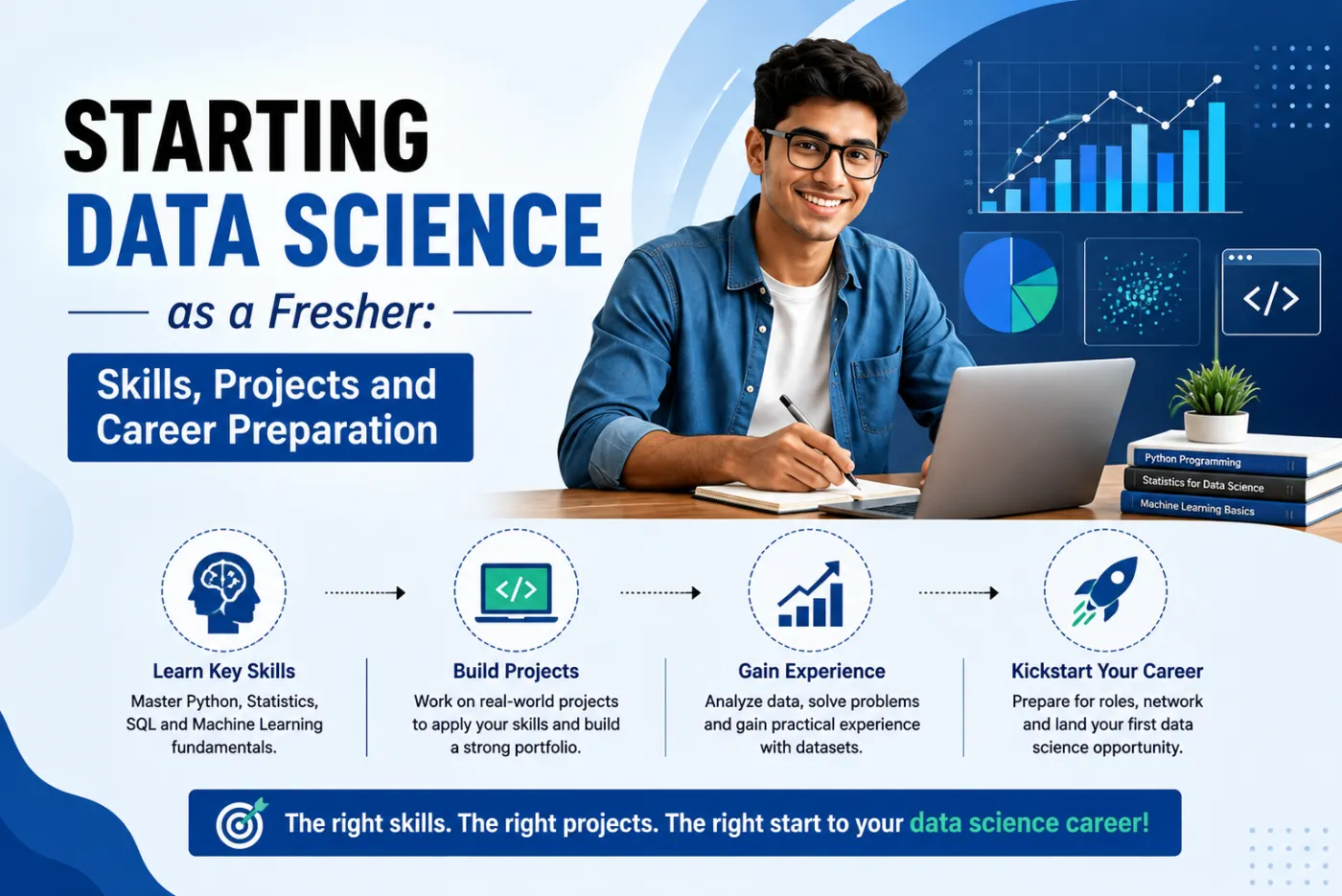
A beginner could think about the learning journey in stages rather than trying to learn everything simultaneously.
The first stage can focus on Python and SQL.
The next stage can introduce statistics, data cleaning, EDA and visualization.
After that, the learner can move into Machine Learning.
Advanced topics such as AI and Generative AI can follow once the foundation is stronger.
Throughout the process, projects should be developed alongside learning.
This creates a much more practical progression than spending months watching lessons without building anything.
Final Thoughts
Data Science can be a promising career area for freshers, but success depends on preparation rather than simply completing a course.
Python, SQL, statistics, data preparation, EDA, visualization, Machine Learning and AI provide a useful technical foundation. Projects then turn those skills into demonstrable experience.
For students considering structured Data Science training in Bangalore, the most important question is not simply which institute has the longest course.
Ask whether the learning process helps you understand, practice, build and explain.
That approach can make the transition from beginner to job seeker much more realistic.