These are some of the most common questions professionals ask before starting their Data Science journey. The good news is that the demand for skilled Data Science professionals has grown far beyond the IT industry. Today, companies value problem-solving, analytical thinking, and practical skills just as much as technical knowledge.
Whether you work in finance, healthcare, sales, education, manufacturing, or customer support, a structured learning path can help you transition into one of the fastest-growing technology careers. If you’re looking for the best data science course in Bangalore, understanding the roadmap before enrolling is the first step toward making an informed career decision.
Why More Non-IT Professionals Are Choosing Data Science
Technology is transforming every industry. Businesses no longer rely only on experience or intuition—they make decisions using data. From predicting customer behaviour to preventing fraud and improving healthcare outcomes, Data Science is helping organisations solve real business problems.
This shift has created opportunities for professionals from diverse educational and career backgrounds.
Some of the most common career switchers include:
- Mechanical and Civil Engineers
- B.Com and BBA Graduates
- MBA Professionals
- Banking and Finance Executives
- Sales and Marketing Professionals
- Healthcare Professionals
- Teachers and Trainers
The reason is simple: Data Science combines technical skills with business understanding. Professionals who already understand customers, operations, finance, or business processes often adapt quickly once they learn Python, SQL, and Machine Learning.
Did You Know?
Many successful Data Analysts and Data Scientists started their careers outside IT. Employers increasingly value practical projects and analytical thinking over having a traditional Computer Science degree.
Why Bangalore Is the Best Place to Start Your Data Science Career
Bangalore continues to be India’s technology capital. It is home to thousands of startups, global technology companies, analytics firms, fintech organisations, healthcare innovators, and AI-driven businesses.
This makes the city one of the best places for aspiring Data Scientists to learn, network, and build rewarding careers.
Why professionals prefer Bangalore
| Advantage | Why It Matters |
|---|---|
| Strong hiring demand | Thousands of analytics and AI roles are available across industries. |
| Diverse industries | Opportunities exist in finance, healthcare, retail, manufacturing, and e-commerce. |
| Startup ecosystem | Startups provide faster learning and broader responsibilities. |
| Higher exposure | Professionals work with real-world AI and data-driven projects. |
| Networking opportunities | Regular tech meetups, conferences, and hackathons help expand professional connections. |
Many leading data science companies in Bangalore actively recruit candidates with practical skills, making the city an excellent destination for career switchers.
Where Is Data Science Used? Real Examples You Already Know
One of the easiest ways to understand Data Science is by looking at the apps and services you use every day.
Flipkart – Personalized Shopping
When Flipkart recommends products based on your previous purchases or browsing history, Data Science is working behind the scenes. Machine Learning models analyse customer preferences to improve shopping experiences.
Swiggy – Smarter Deliveries
Swiggy uses predictive analytics to estimate delivery times, optimise delivery routes, and match orders with nearby delivery partners. This improves efficiency and customer satisfaction.
PhonePe – Secure Transactions
Digital payment platforms rely on AI to detect unusual transaction patterns and reduce fraudulent activities in real time.
These examples show that Data Science is not limited to technology companies. It is solving business problems across multiple industries.
Skills Every Career Switcher Should Learn
Many beginners assume they need to master dozens of programming languages before applying for jobs. In reality, most entry-level Data Science roles require a focused set of practical skills.
| Skill | Why It Is Important |
| Python | The most widely used programming language for Data Science and Machine Learning. |
| SQL | Helps retrieve and analyse data stored in databases. |
| Statistics | Enables professionals to understand trends, patterns, and business insights. |
| Power BI or Tableau | Converts raw data into interactive dashboards for decision-making. |
| Machine Learning | Builds predictive models that solve real business problems. |
| Generative AI | Increasingly important for modern AI applications, automation, and productivity. |
If you’re looking for a python for data science course Bangalore, ensure it starts with programming fundamentals before progressing to Machine Learning and Generative AI. A structured curriculum makes learning more manageable, especially for professionals without prior coding experience.
Myth vs Reality: Can Non-IT Professionals Really Succeed?
One of the biggest barriers to switching careers is self-doubt. Let’s separate common myths from reality.
| Myth | Reality |
| Only Computer Science graduates become Data Scientists. | Professionals from commerce, engineering, healthcare, and management are successfully entering the field. |
| You must be an expert programmer before starting. | Python is beginner-friendly and can be learned step by step. |
| Mathematics needs to be advanced. | A solid understanding of basic statistics and logical reasoning is enough to begin. |
| Companies hire only experienced IT professionals. | Employers value practical projects, problem-solving ability, and continuous learning. |
The key to a successful transition isn’t your previous job title—it’s your willingness to learn, practise, and build a portfolio that demonstrates your skills.
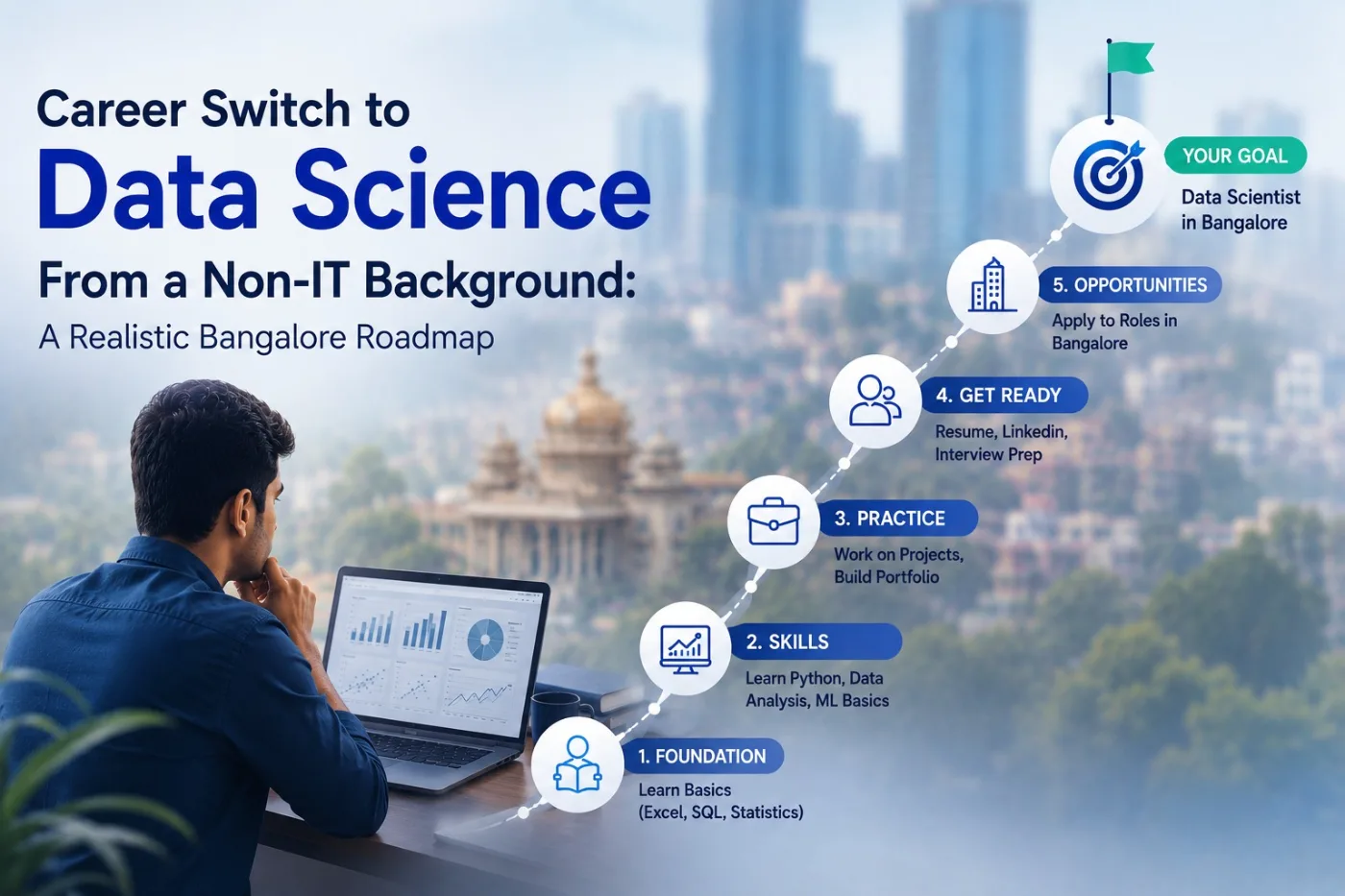
A Step-by-Step Roadmap to Become a Data Scientist
A successful career transition doesn’t happen overnight. Instead of trying to learn everything at once, follow a structured roadmap that builds your confidence and practical skills.
Step 1: Learn Python
Python is the foundation of Data Science because of its simple syntax and powerful libraries.
Focus on learning:
- Variables and Data Types
- Functions
- Loops and Conditions
- File Handling
- Object-Oriented Programming
- NumPy and Pandas
Goal: Become comfortable writing clean, reusable Python code before moving to advanced topics.
Step 2: Learn SQL and Data Analysis
Almost every organisation stores business data in databases. SQL allows you to retrieve, filter, and analyse that data.
Key topics include:
- SELECT statements
- Joins
- Aggregate Functions
- Group By
- Subqueries
- Window Functions
Pair SQL with Excel and Pandas to understand how businesses clean and prepare data before analysis.
Step 3: Build a Strong Foundation in Statistics
You don’t need advanced mathematics, but you should understand concepts that help you interpret data correctly.
Learn:
- Mean, Median, and Mode
- Probability
- Correlation
- Standard Deviation
- Hypothesis Testing
- Data Distribution
These concepts are used frequently in Data Science interviews and real-world business analysis.
Step 4: Learn Machine Learning
Machine Learning helps computers identify patterns and make predictions using historical data.
Start with beginner-friendly algorithms such as:
- Linear Regression
- Logistic Regression
- Decision Trees
- Random Forest
- K-Means Clustering
Once you’re comfortable, explore advanced topics like Natural Language Processing (NLP), Deep Learning, and Generative AI.
Step 5: Build Real Projects
Recruiters rarely hire candidates based only on certificates. They want proof that you can solve business problems.
Start with projects such as:
| Beginner Project | Skills You’ll Demonstrate |
|---|---|
| House Price Prediction | Regression, Python |
| Customer Churn Analysis | Data Cleaning, Machine Learning |
| Sales Dashboard | Power BI, SQL |
| Employee Attrition Prediction | Classification |
| Movie Recommendation System | Recommendation Algorithms |
| Sentiment Analysis | NLP and Text Analytics |
A strong portfolio with 8–10 projects can significantly improve your interview opportunities.
Step 6: Prepare for Interviews
Once you’ve built your projects, focus on interview preparation.
This includes:
- Python coding practice
- SQL query writing
- Machine Learning concepts
- Resume building
- GitHub portfolio
- LinkedIn profile optimisation
- Mock interviews
These are often the final steps that help candidates convert learning into job offers.
Common Mistakes Career Switchers Should Avoid
Many learners spend months studying but struggle during interviews because they make avoidable mistakes.
Here are some of the most common ones:
❌ Learning only Python and ignoring SQL
❌ Watching tutorials without practising
❌ Copying projects from GitHub instead of building your own
❌ Applying for jobs without a professional resume
❌ Ignoring interview preparation
❌ Choosing courses that focus only on theory
The fastest learners are those who consistently practise, build projects, and seek feedback from experienced mentors.
Career Opportunities After Completing Data Science Training
After completing professional data science training in Bangalore, career switchers can apply for a variety of roles depending on their interests and skill level.
Popular job roles include:
- Data Analyst
- Business Analyst
- Junior Data Scientist
- Machine Learning Engineer
- AI Engineer
- Business Intelligence Developer
- Data Engineer
- Analytics Consultant
These opportunities are available across industries such as banking, healthcare, retail, manufacturing, logistics, education, and e-commerce.
Many leading artificial intelligence company in Bangalore organisations are also expanding their AI and Machine Learning teams, creating exciting opportunities for professionals with practical skills.
Why Choose NUCOT for Your Career Transition?
Finding the right learning partner is just as important as choosing the right career.
If you’re searching for data science courses in Bangalore that focus on practical learning rather than just classroom theory, NUCOT offers a structured approach designed specifically for beginners and career switchers.
What makes NUCOT different?
- Industry-focused curriculum
- Python from beginner to advanced level
- SQL and Data Analysis
- Machine Learning and Deep Learning
- Generative AI modules
- Power BI and Tableau
- Real-world capstone projects
- Resume and LinkedIn optimisation
- Mock interviews
- Placement assistance
Unlike many traditional training programs, NUCOT focuses on helping learners become job-ready by combining technical knowledge with hands-on experience.
Whether you’re exploring AI courses in Bangalore, looking for the best AI training, or searching for comprehensive data science training in Bangalore, practical learning and consistent mentorship can make all the difference in your career journey.
Frequently Asked Questions
Can I become a Data Scientist without an IT background?
Yes. Many professionals from commerce, engineering, healthcare, banking, and marketing have successfully transitioned into Data Science by learning the right skills and building practical projects.
How long does it take to become job-ready?
The timeline varies depending on your learning pace and dedication. Consistent practice, project work, and interview preparation are often more important than completing a course quickly.
Is Python enough to get a Data Science job?
Python is essential, but employers also expect knowledge of SQL, statistics, data visualisation, Machine Learning, and project experience.
Which industries hire Data Science professionals?
Banking, healthcare, e-commerce, manufacturing, retail, education, telecommunications, and logistics all rely on Data Science for business decision-making.
Do I need a Computer Science degree?
No. Recruiters increasingly evaluate candidates based on their skills, portfolio, problem-solving ability, and practical experience rather than their academic background alone.
Final Thoughts
Switching to Data Science from a non-IT background may seem challenging at first, but it is entirely achievable with the right learning path and consistent effort. The demand for skilled professionals continues to grow, especially among data science companies in Bangalore, where businesses are investing heavily in analytics, Artificial Intelligence, and Machine Learning.
Rather than trying to learn everything independently, choose a structured program that combines technical training with practical projects and career guidance.
If you’re ready to build a future-proof career, enrolling in one of the best data science course in Bangalore can be the first step toward achieving your goals. At NUCOT, you’ll gain practical experience, industry-relevant skills, and placement assistance designed to help career switchers confidently enter the world of Data Science and Artificial Intelligence.
Your career doesn’t have to be limited by your past experience. With the right roadmap, your next opportunity could be in Data Science.