Imagine searching for a professional training institute and finding several completely different opinions.
One student recommends the institute. Another describes a concern. A third talks mainly about the trainer, while someone else focuses on placement support.
Which opinion should you trust?
The answer isn’t necessarily the most positive review or the most critical one.
The more useful approach is to understand what the review actually tells you and whether that information is relevant to your own situation.
This is especially important when researching NUCOT reviews before choosing a Data Science, AI or other technology training program.
A Review Is a Personal Experience
Every review comes from a particular learner.
That learner has a specific background, expectation and objective.
A fresher starting with no programming experience may evaluate a course differently from an experienced software professional.
A learner who wants career guidance may focus heavily on placement support, while someone already employed may care more about advanced technical skills.
This doesn’t make one experience more valid than another. It simply means that context matters.
Look for Details, Not Just Ratings
Consider two hypothetical reviews.
One says:
“Very good institute.”
Another explains:
“The program gave me practical exposure to Python, SQL and data analysis, and I worked on projects during the training.”
The second provides much more information.
When reading NUCOT reviews, look for details about what was actually experienced.
Was the review about the curriculum?
Was it about the trainer?
Was it about projects?
Was it about career preparation?
Was it written by a fresher or an experienced professional?
Those details help you determine whether the review is relevant to you.
Positive Feedback Can Be Useful
Students often search for NUCOT positive reviews because they want to know what previous learners appreciated.
Positive feedback can provide clues about aspects such as practical learning, trainer interaction, projects and classroom experience.
However, a positive review should be treated as an individual experience rather than a guarantee of identical results.
The most useful positive feedback usually explains why the learner had a good experience.
Negative Feedback Can Be Useful Too
The same principle applies to NUCOT negative reviews.
A critical review can identify something that a prospective student should investigate.
For example, if someone expresses concern about project exposure, the appropriate response isn’t automatically to accept or reject the claim.
Instead, ask the institute how projects are currently handled.
If someone raises a question about placement assistance, ask what career support is included.
This transforms negative feedback into useful research.
Freshers Need More Context
A fresher’s expectations are often different from those of an experienced professional.
Someone entering Data Science for the first time may need a strong foundation in Python, SQL and statistics.
They may also require additional support when building their first projects.
Therefore, NUCOT freshers reviews can be useful when they provide details about how beginners experienced the learning journey.
But prospective freshers should still compare those experiences with their own educational and technical background.
Placement Reviews Require Particular Attention
Career outcomes are naturally important when selecting professional training.
This is why NUCOT placement reviews are likely to attract significant attention from prospective learners.
However, students should distinguish between:
learning the required skills,
receiving career preparation,
and being selected by an employer.
These are related but different stages.
Career preparation can help a candidate become more confident with resumes, interviews and job applications. Actual selection depends on the employer’s requirements and the candidate’s performance.
Understanding this distinction can make placement-related reviews much easier to interpret.
Compare Reviews With the Course Curriculum
Reviews tell you about experiences.
The course page tells you what the current program is designed to teach.
Both sources should be considered.
Suppose you are looking for a Data Science course in Bangalore and the curriculum includes Python, SQL, statistics, Machine Learning, AI and Generative AI.
Look at how those topics are taught.
Then compare that with what students say about their experience.
This gives you a more complete picture.
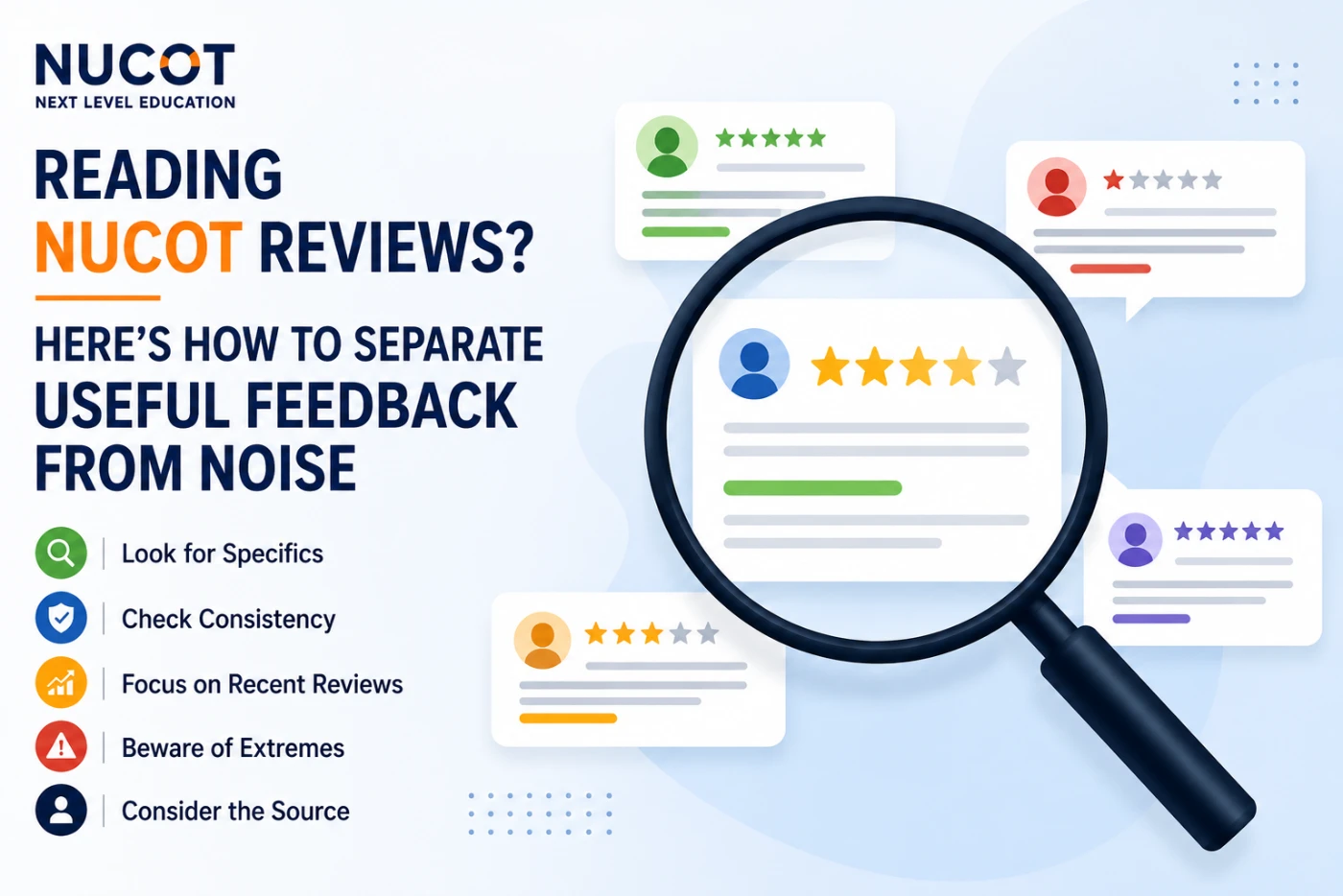
Five Questions to Ask When Reading Any Review
Instead of asking whether a review is positive or negative, ask:
Who wrote it?
What course did they take?
What specifically did they experience?
What were their expectations?
Is their situation similar to mine?
These five questions can dramatically improve the quality of your research.
Don’t Ignore the Date
Training programs can evolve.
Curricula change. Trainers change. Delivery methods change. Technology changes.
Therefore, an older review may not accurately describe the current program.
When possible, check the date of the feedback and compare it with current course information.
This is particularly important in rapidly evolving areas such as Generative AI.
Use Reviews to Build Questions
This is perhaps the most valuable way to use reviews.
Instead of allowing a review to make the decision for you, let it tell you what you need to ask.
If a learner praises practical work, ask how projects are currently structured.
If another learner mentions difficulty with the course, consider whether your current technical background is similar.
If someone talks about placement assistance, clarify the current career-support process.
The review becomes the beginning of your research rather than the end.
Conclusion
Reading NUCOT reviews can be a useful part of choosing a training program, but online feedback becomes much more valuable when you understand its context.
Positive reviews can help identify strengths. Negative reviews can highlight questions. Fresher experiences can help beginners understand whether a program fits their starting point, while placement reviews can help students clarify career-support expectations.
The objective isn’t to eliminate every conflicting opinion.
It is to understand those opinions well enough to make an informed decision.